
Apollo landing sites
Apollo on tonight's Moon Apollo on the Moon of
The six landing sites, and Apollo 13's planned one, placed on the Moon as it looks from where you are. Each pin is in sunlight or lunar night the way the site is right now. Pick a site for its mission dossier.
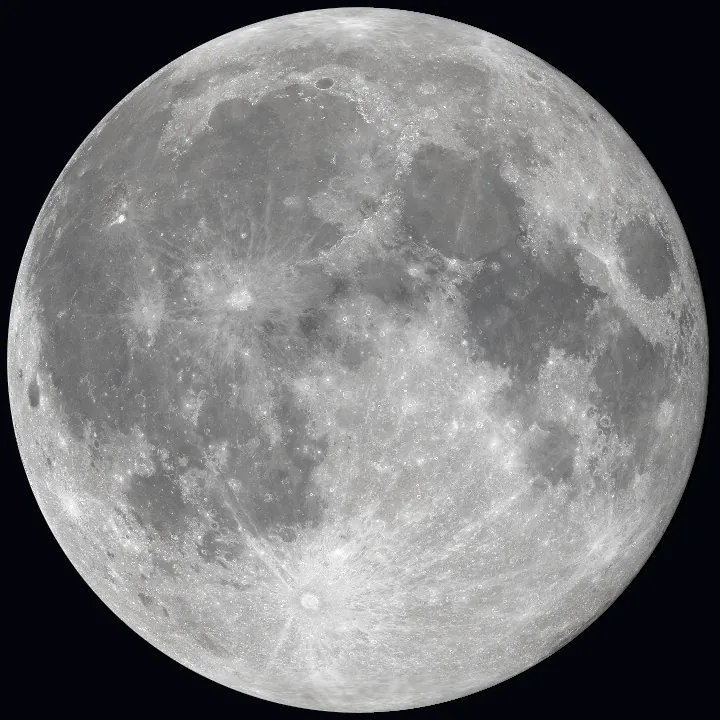
Site in sunlightSite in lunar nightPlanned, never reached
Clear-sky view: clouds and weather are not shown. Rendered from NASA Lunar Reconnaissance Orbiter maps.
The near side face on, north up, as at full Moon. With JavaScript on, this shows the Moon as it looks from your location right now.
Apollo 12
Apollo 12
Ocean of Storms, beside Surveyor 3, Oceanus Procellarum · 3.012° S, 23.422° W
- Commander
- Charles “Pete” Conrad Jr.
- Command module pilot
- Richard F. Gordon Jr.
- Lunar module pilot
- Alan L. Bean
- Command module
- Yankee Clipper
- Lunar module
- Intrepid
The pinpoint landing: struck by lightning on the way up, it set down 163 m535 feet from Surveyor 3 and deployed the first ALSEP.
- Landed
- 19 November 196906:54 UTC
- Time on the Moon
- 31 h 31 minliftoff 20 November 1969
- Moonwalks
- 7 h 45 min2 moonwalks · ≈ 2.3 km1.4 miles on foot
- Samples
- 34.35 kg75.7 lb
- Farthest from the lunar module
- ≈ 410 m1,350 feeton foot
- Mission
- 10 d 4 h 36 min45 lunar orbits · USS Hornet
-
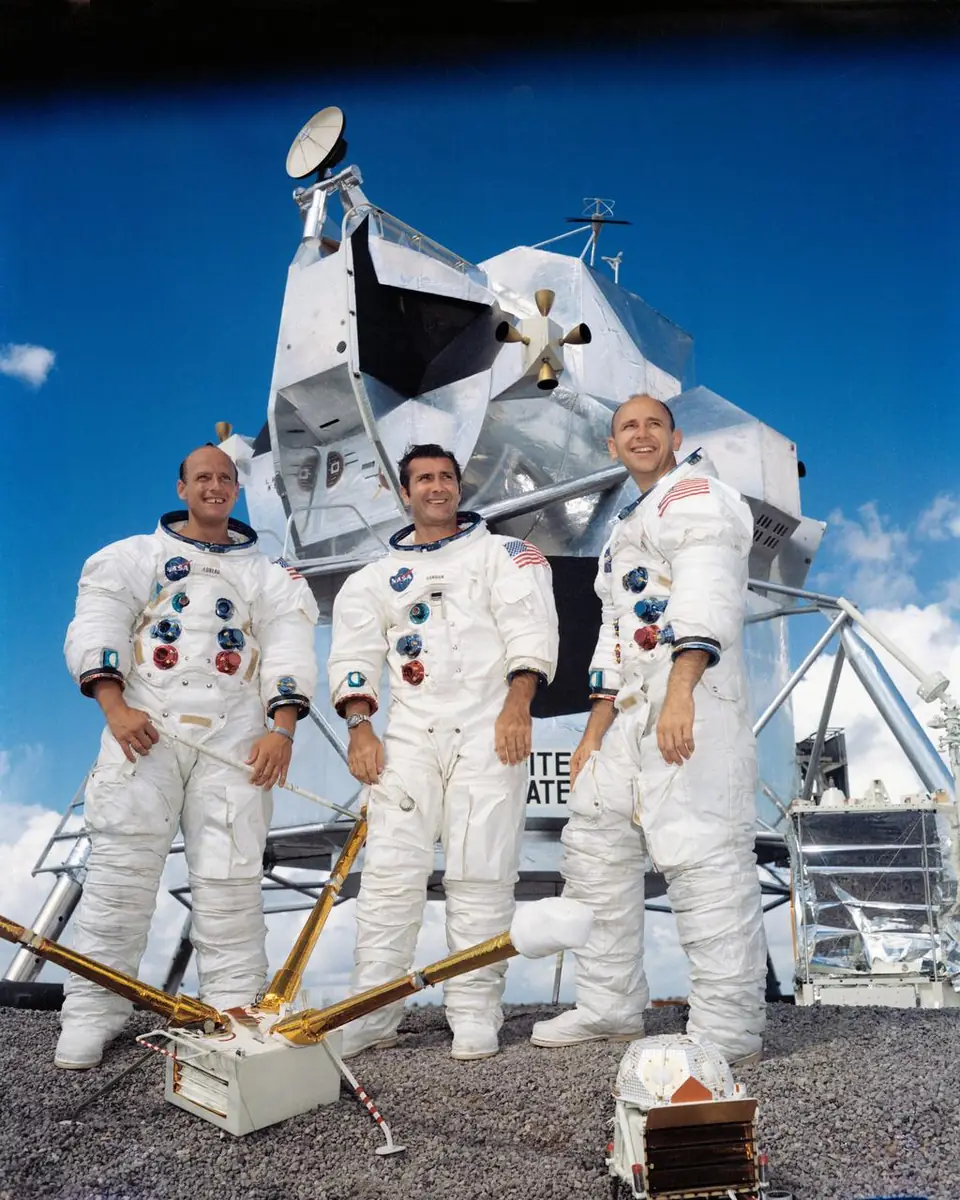
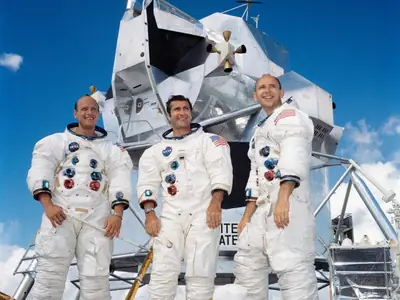 Prime crew portrait: Pete Conrad, Dick Gordon and Alan Bean.
-
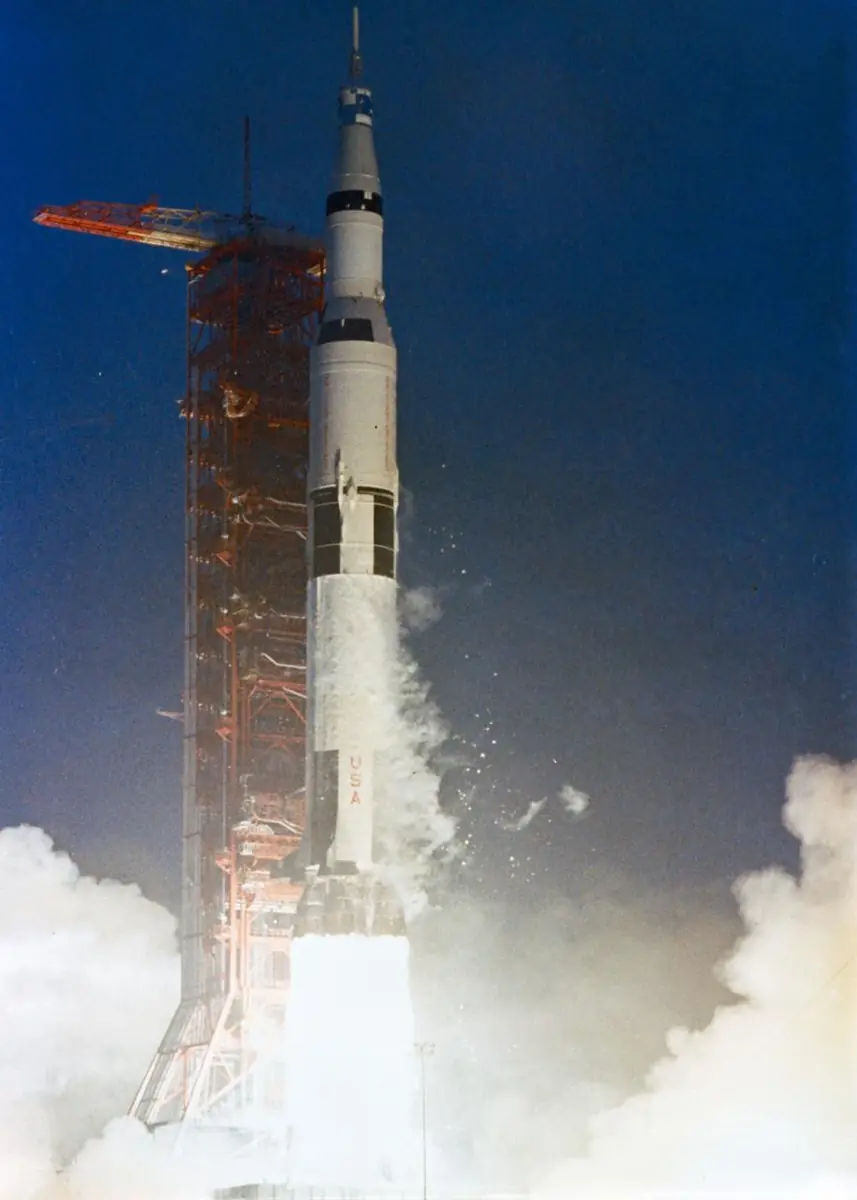
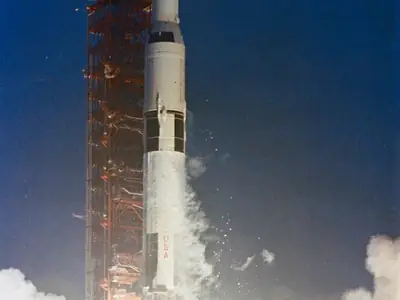 SA-507 lifts off into overcast skies, 14 November 1969.
-
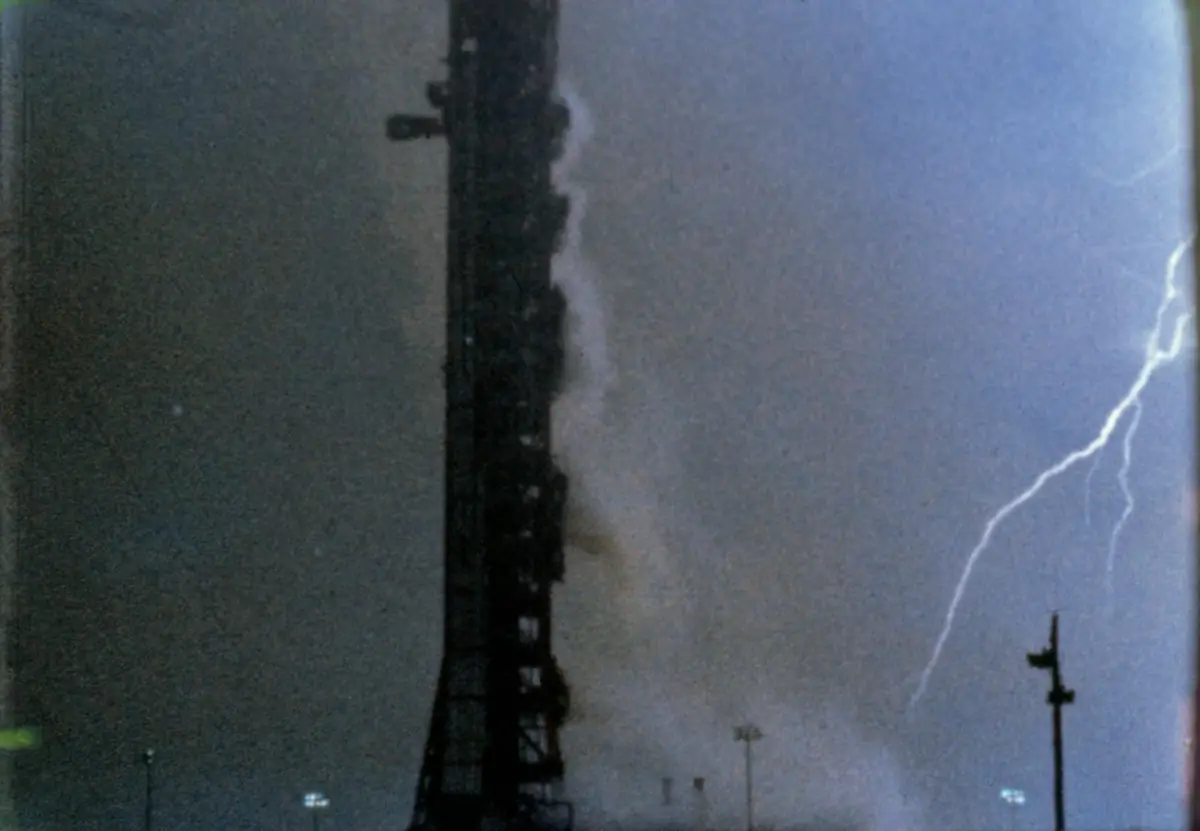
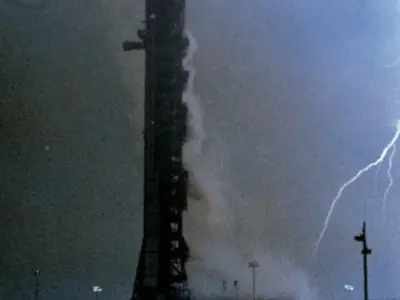 Lightning strikes near Pad 39A during the launch (frame from 16 mm film).
-
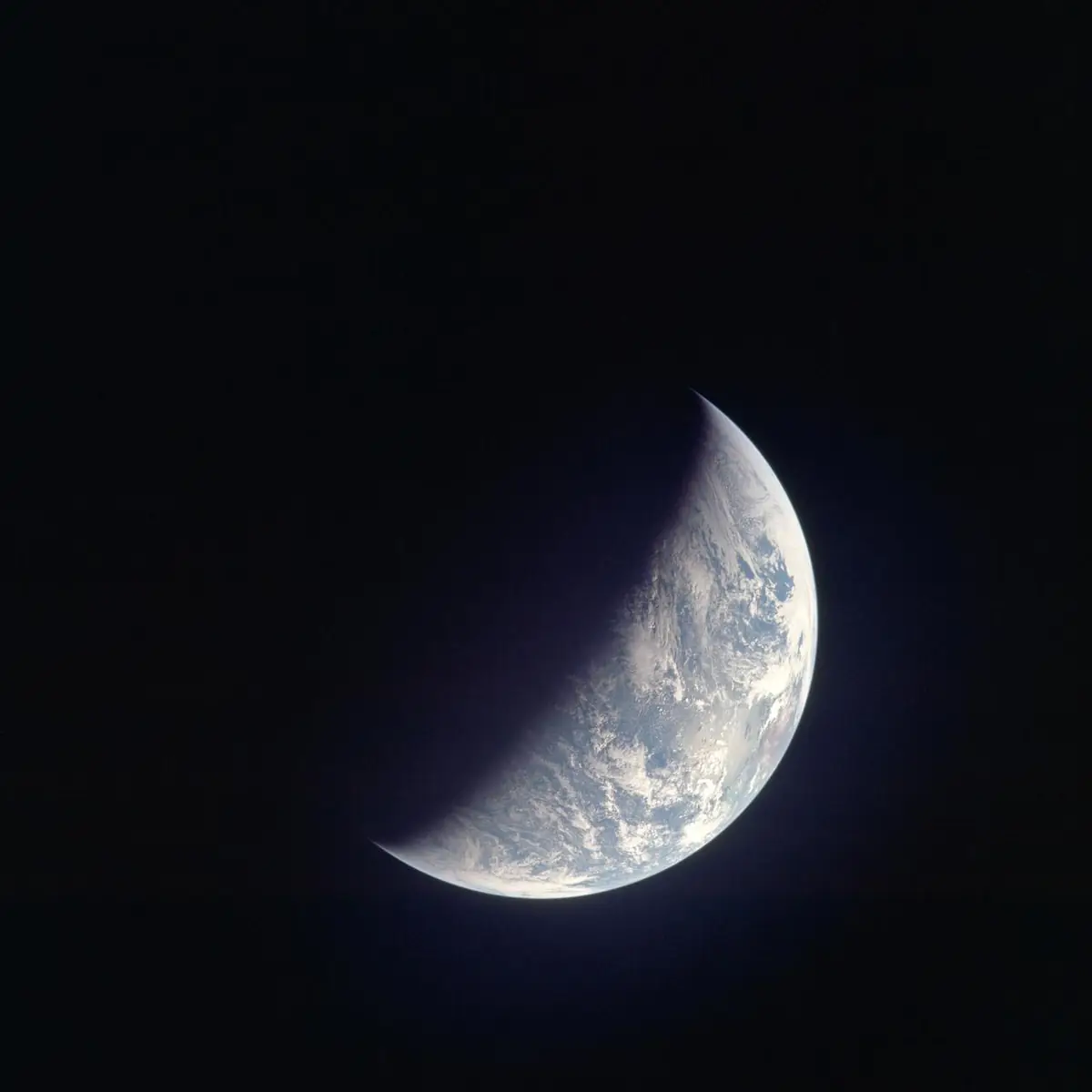
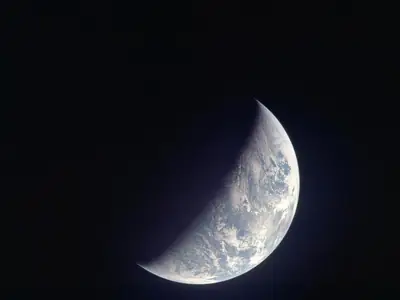 A crescent Earth, with Australia on the horizon, on the way to the Moon.
-
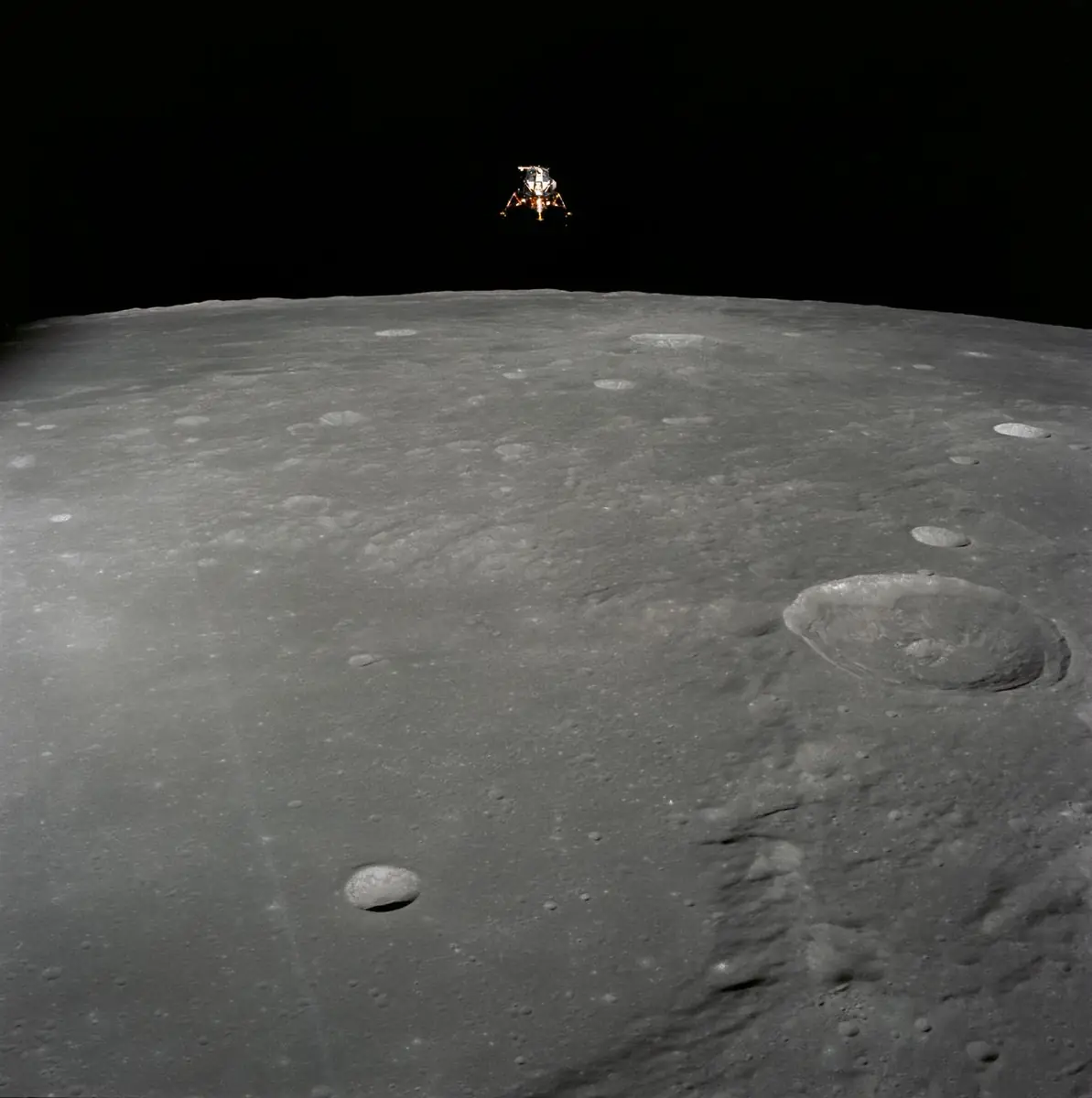
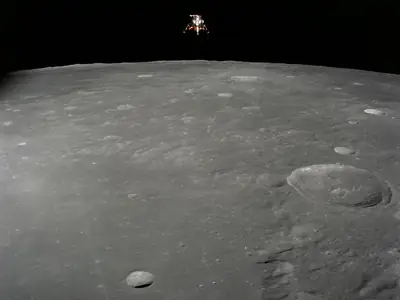 Intrepid in landing configuration over the crater Ptolemaeus.
-
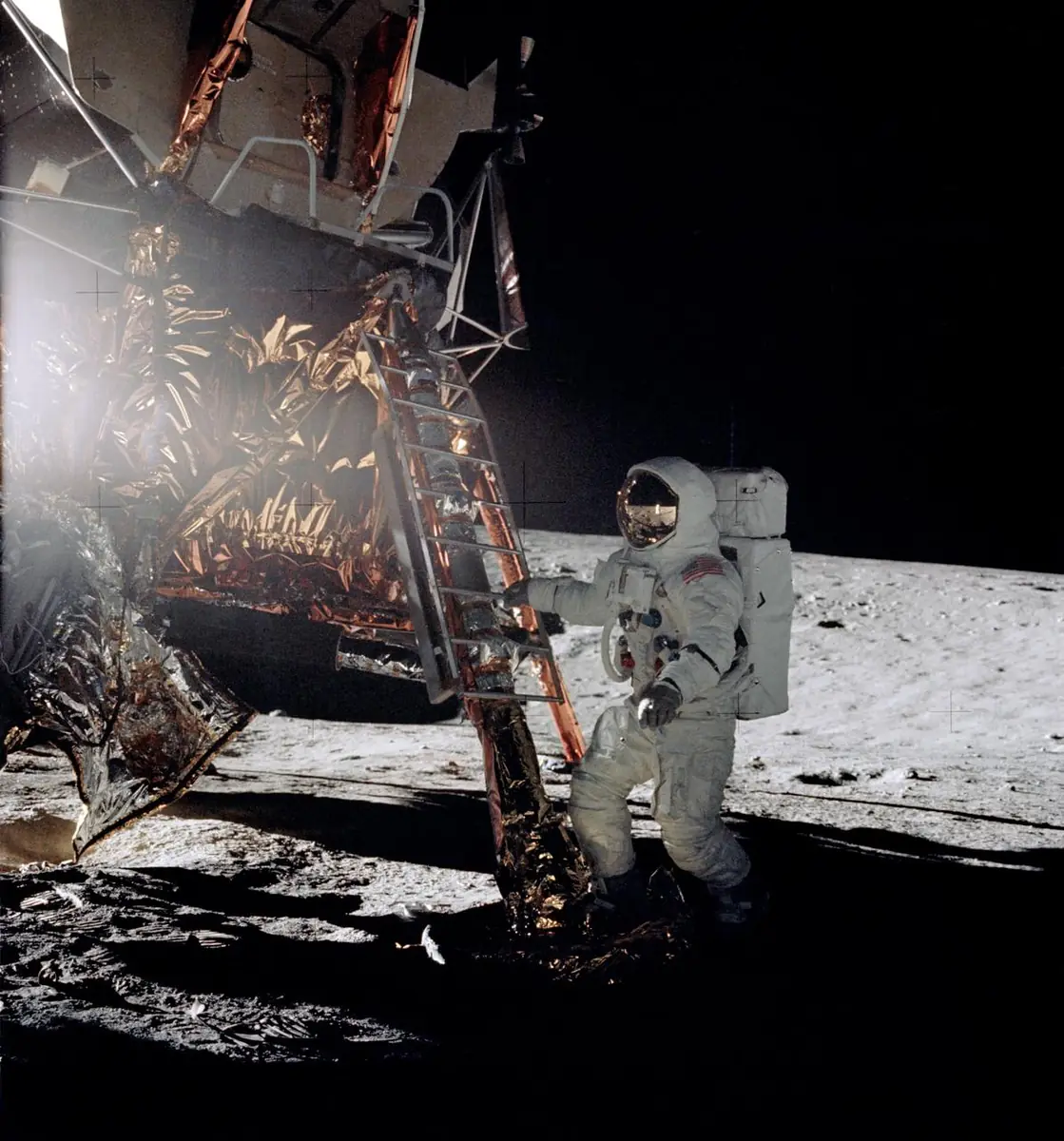
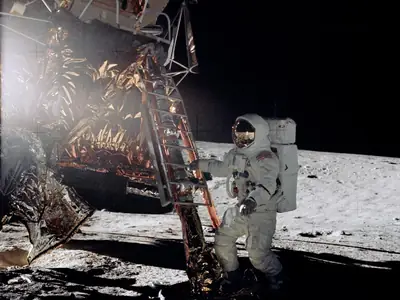 Bean steps off Intrepid's ladder onto the Ocean of Storms.
-
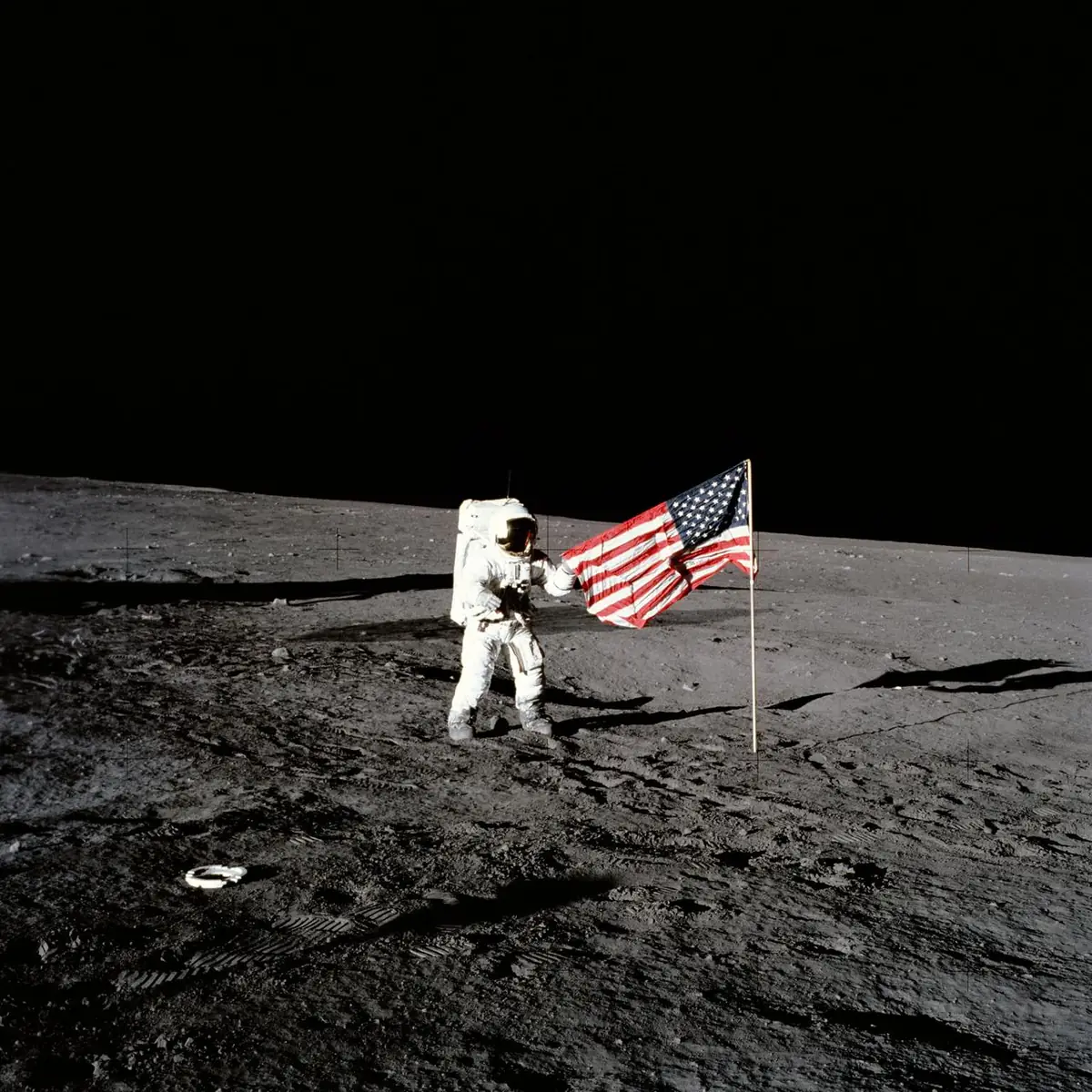
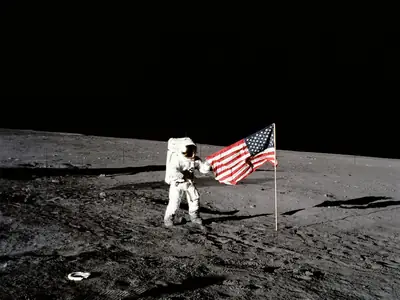 Conrad beside the flag soon after it was unfurled.
-
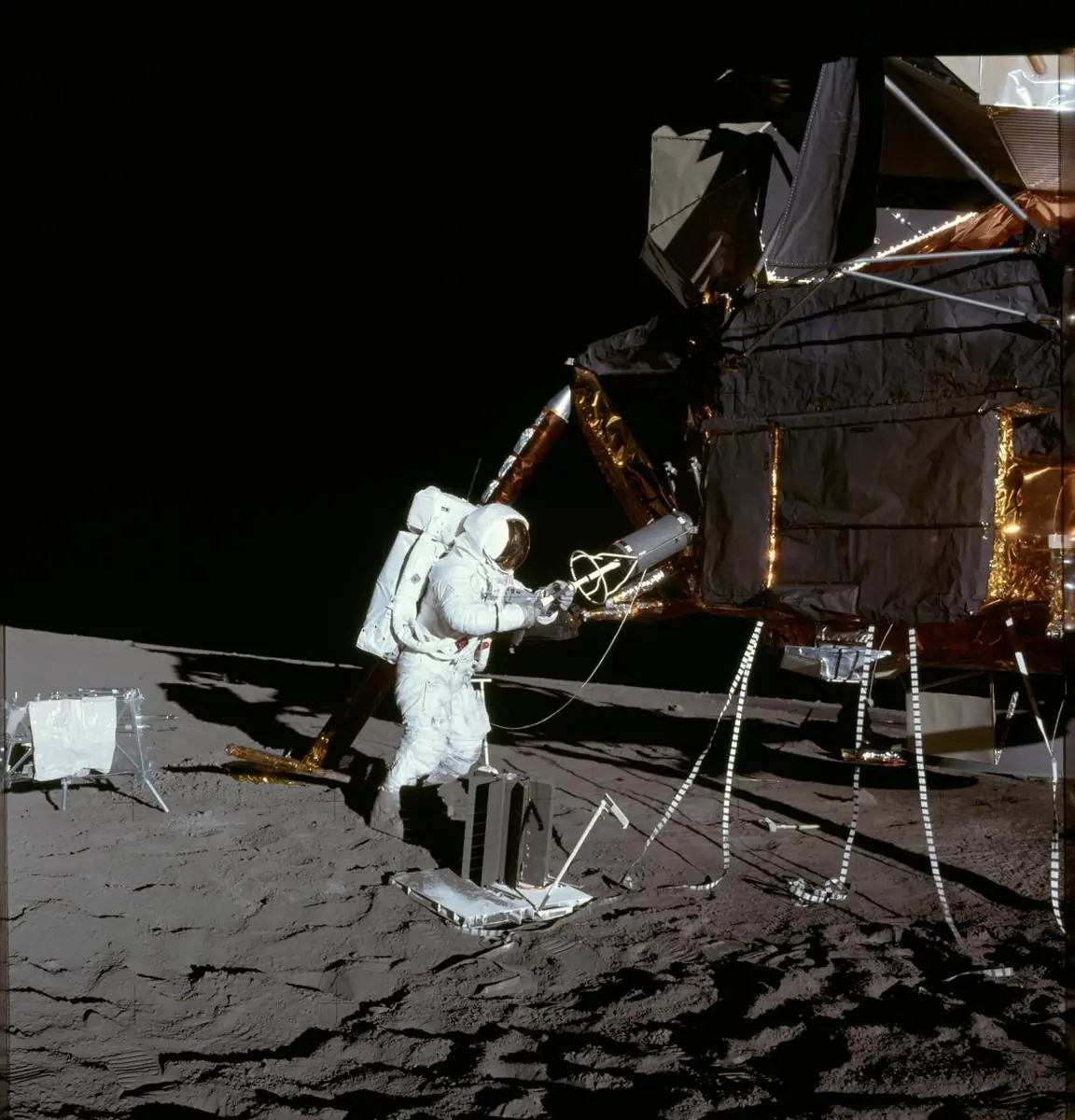
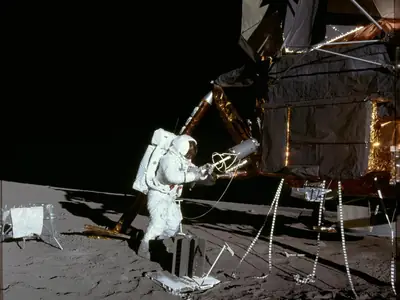 Bean unloads the RTG fuel element from the LM's descent stage.
-
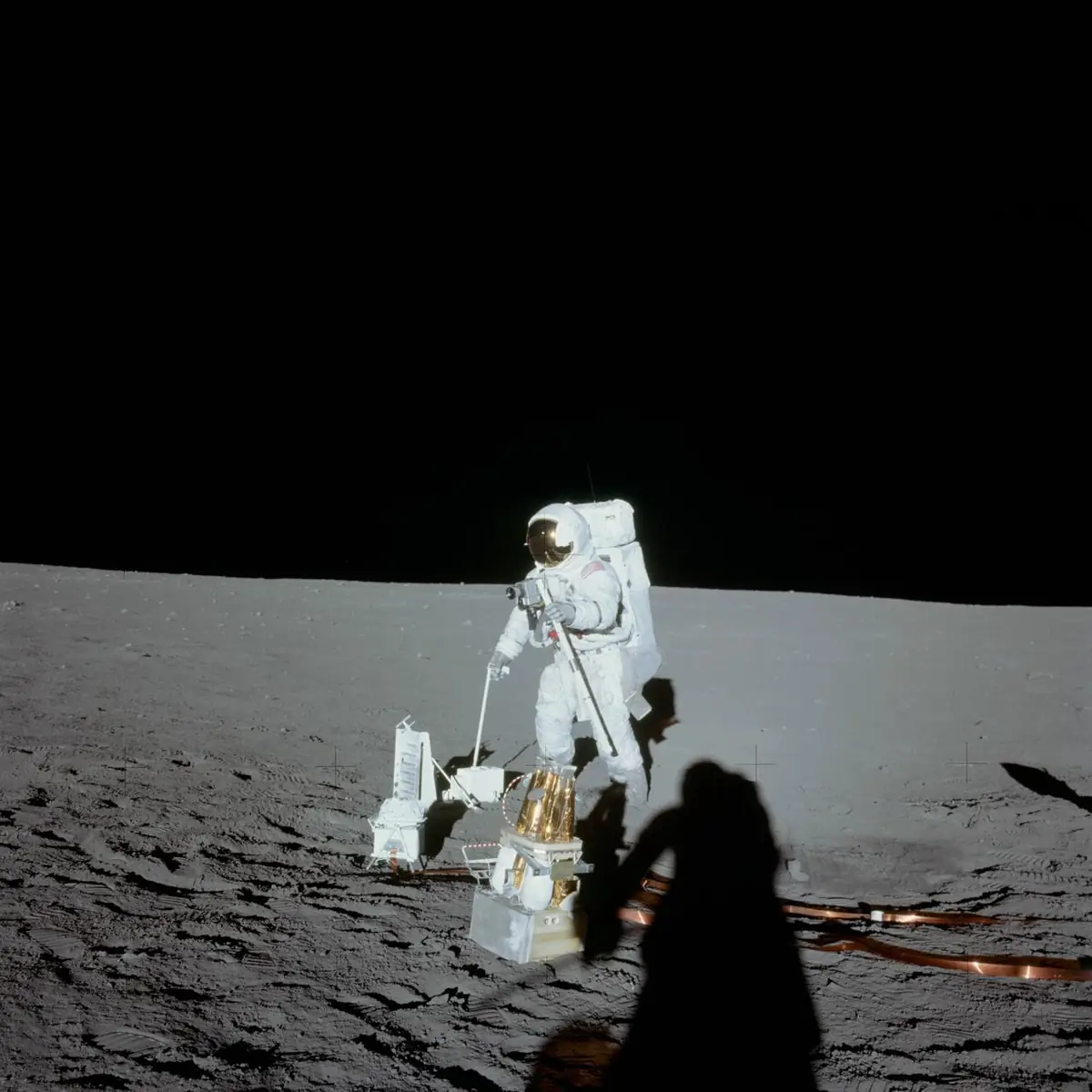
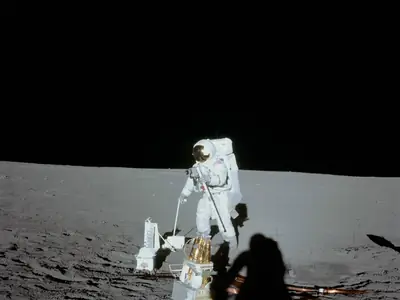 Bean deploys the ALSEP during the first EVA.
-
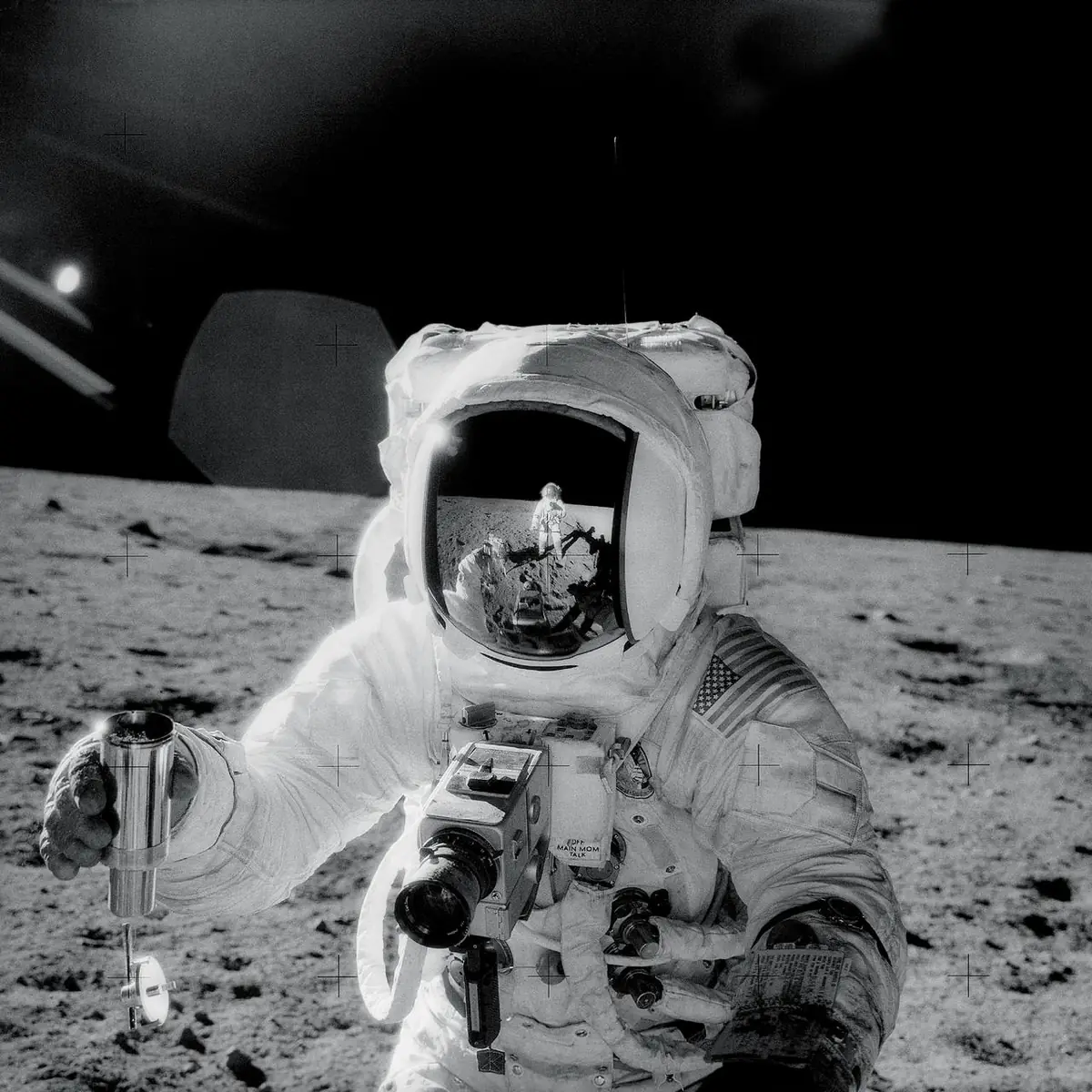
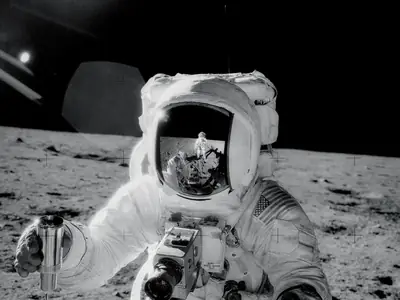 Bean holds a special environmental sample container; Conrad is reflected in his visor.
-
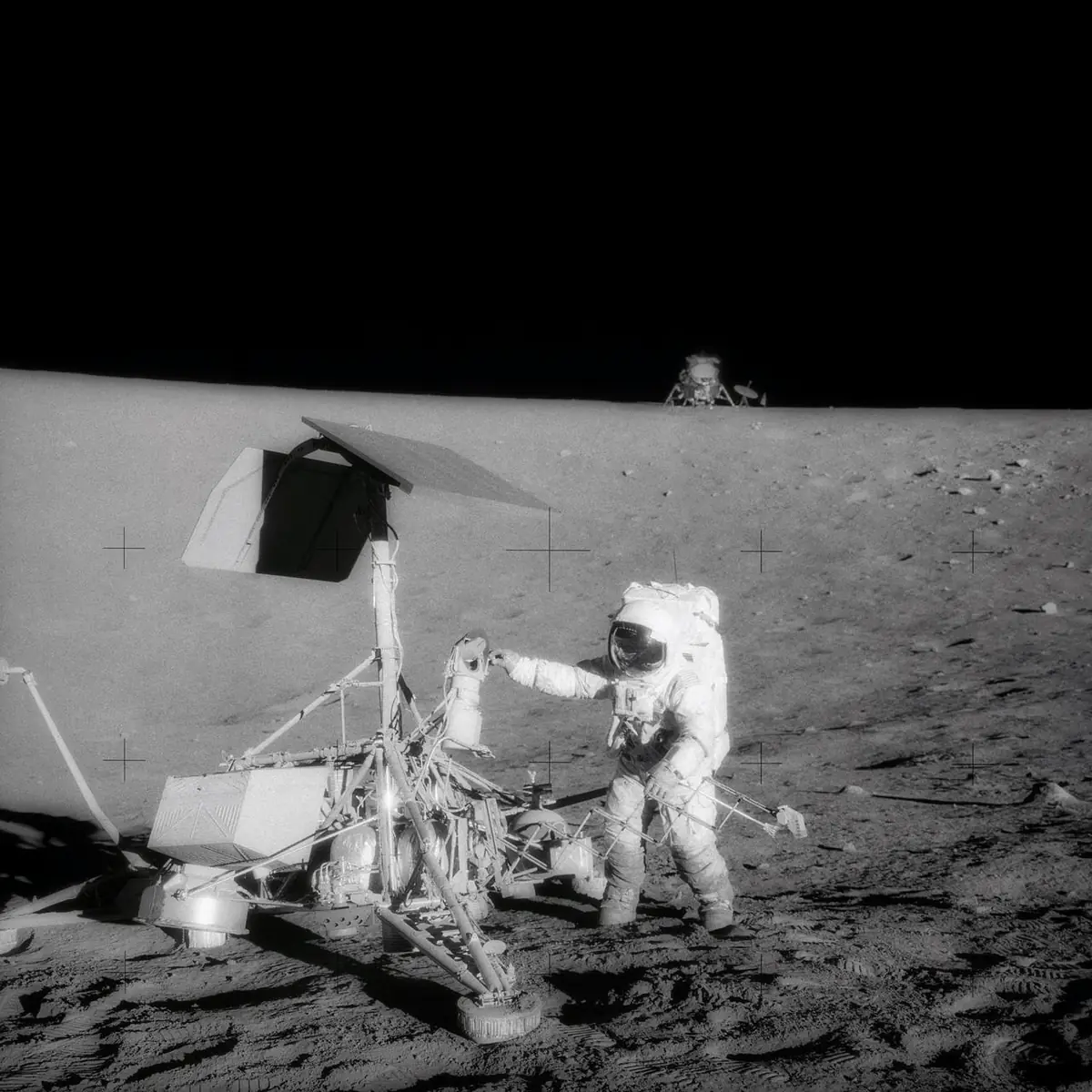
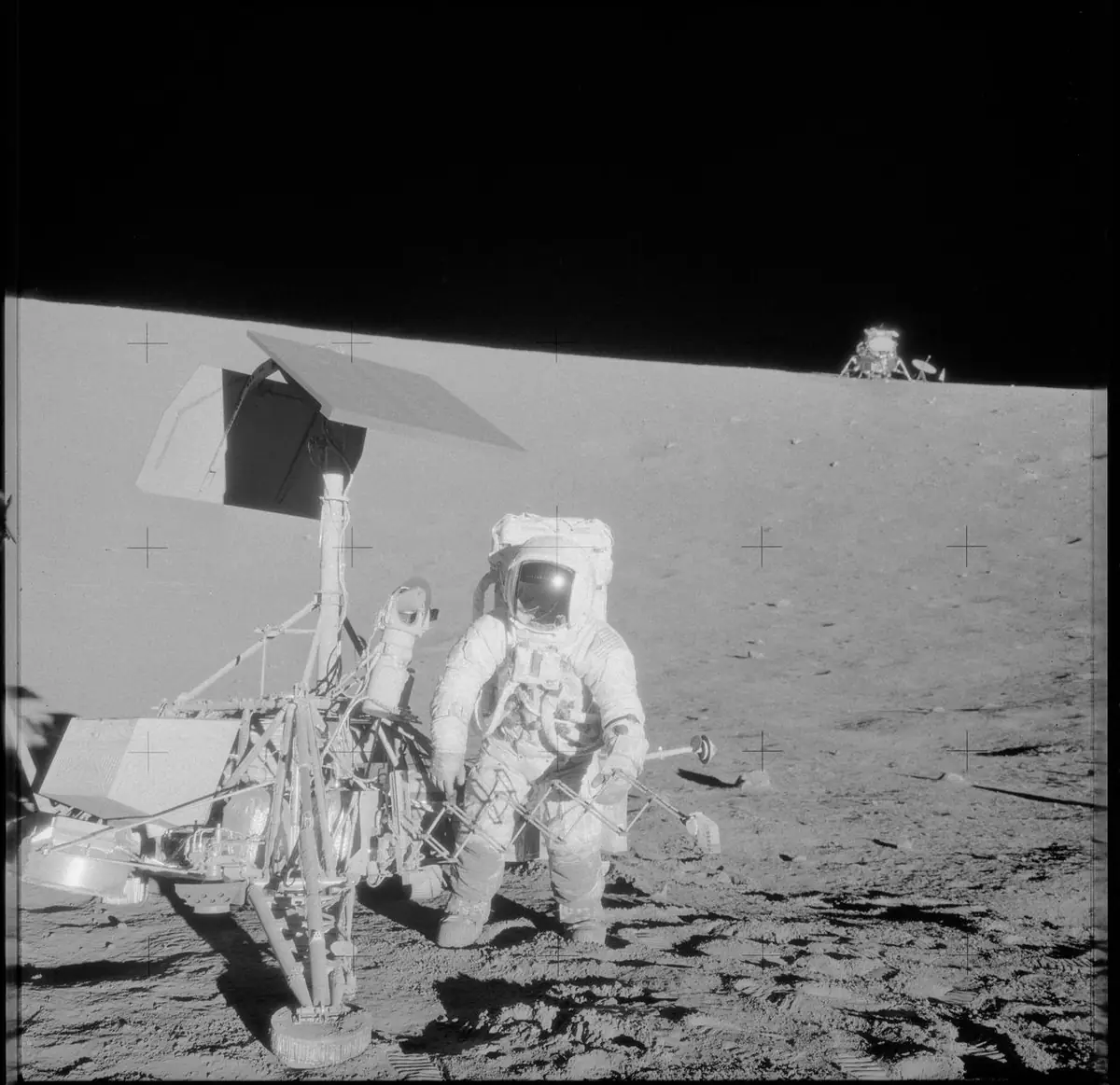
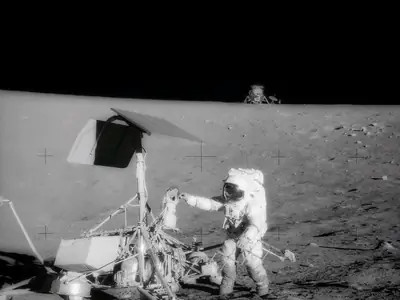 Two U.S. spacecraft on the Moon: Surveyor 3 in front, Intrepid on the horizon.
-
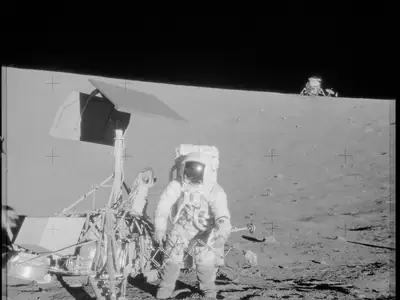 Conrad examines Surveyor 3, with Intrepid about 160 m525 feet behind.
-
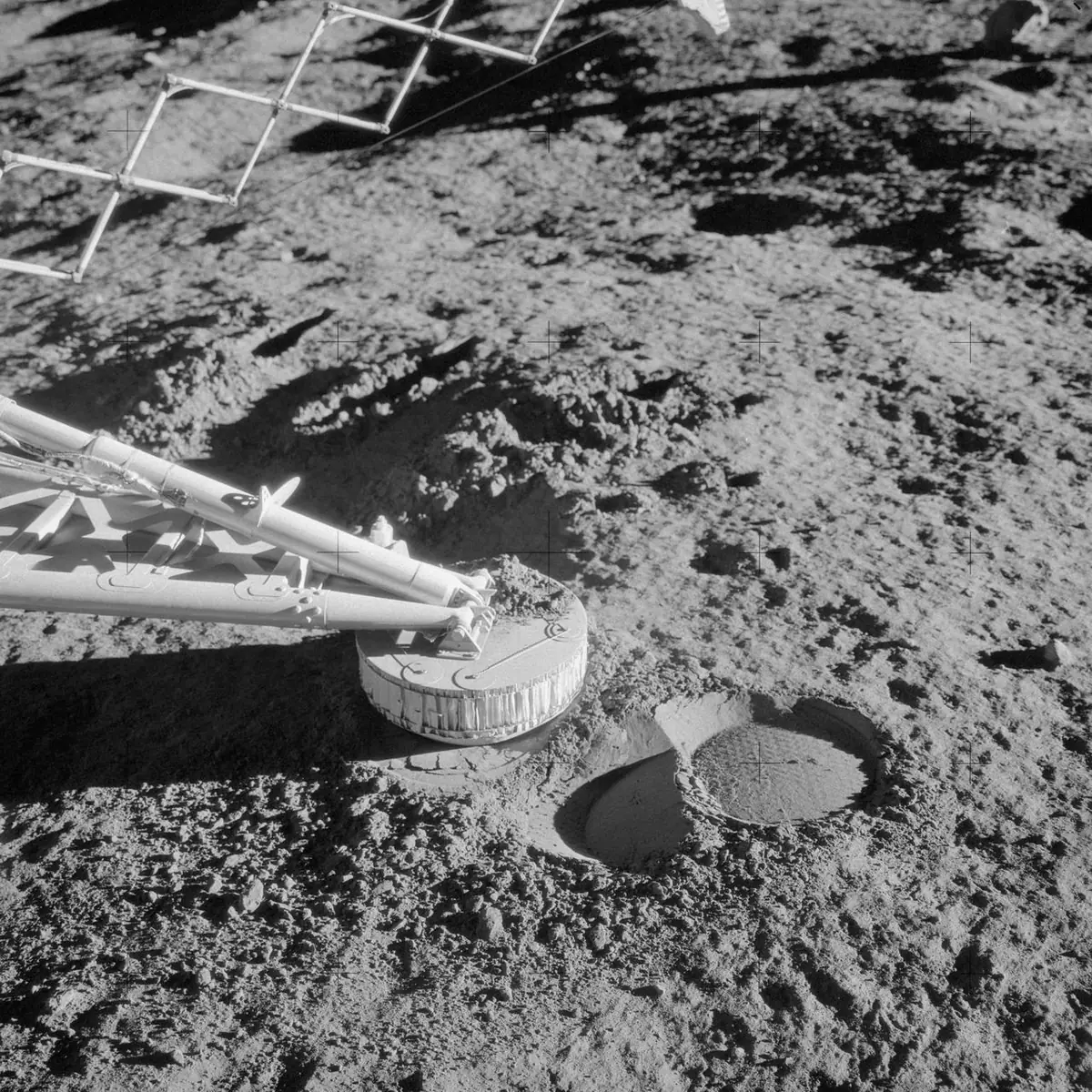
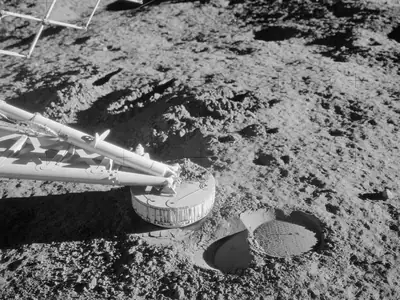 Surveyor 3's footpad and its sampling scoop after 31 months on the Moon.
-
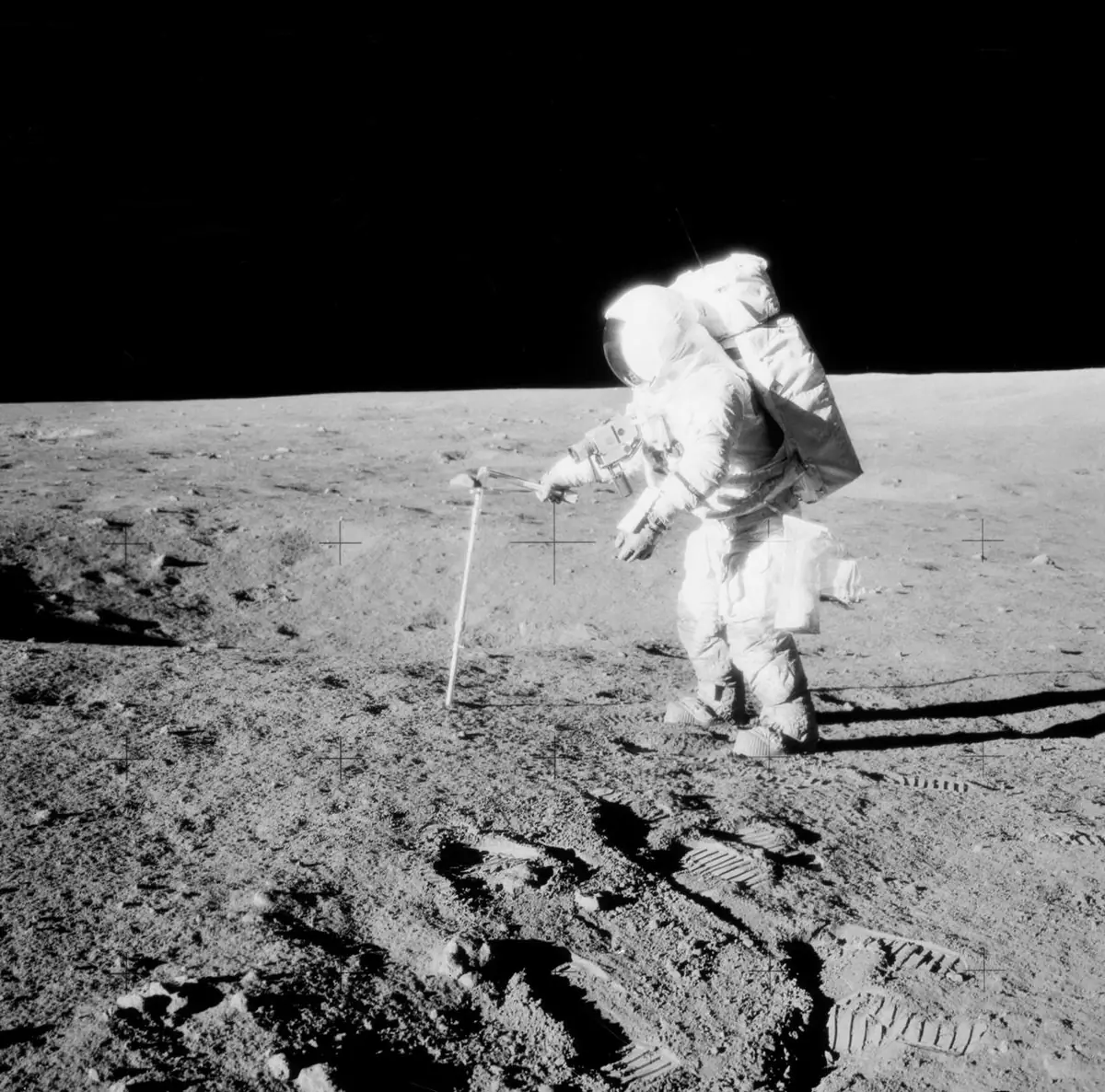
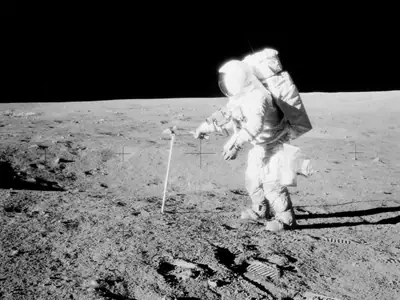 Bean drives a core tube into the surface.
-
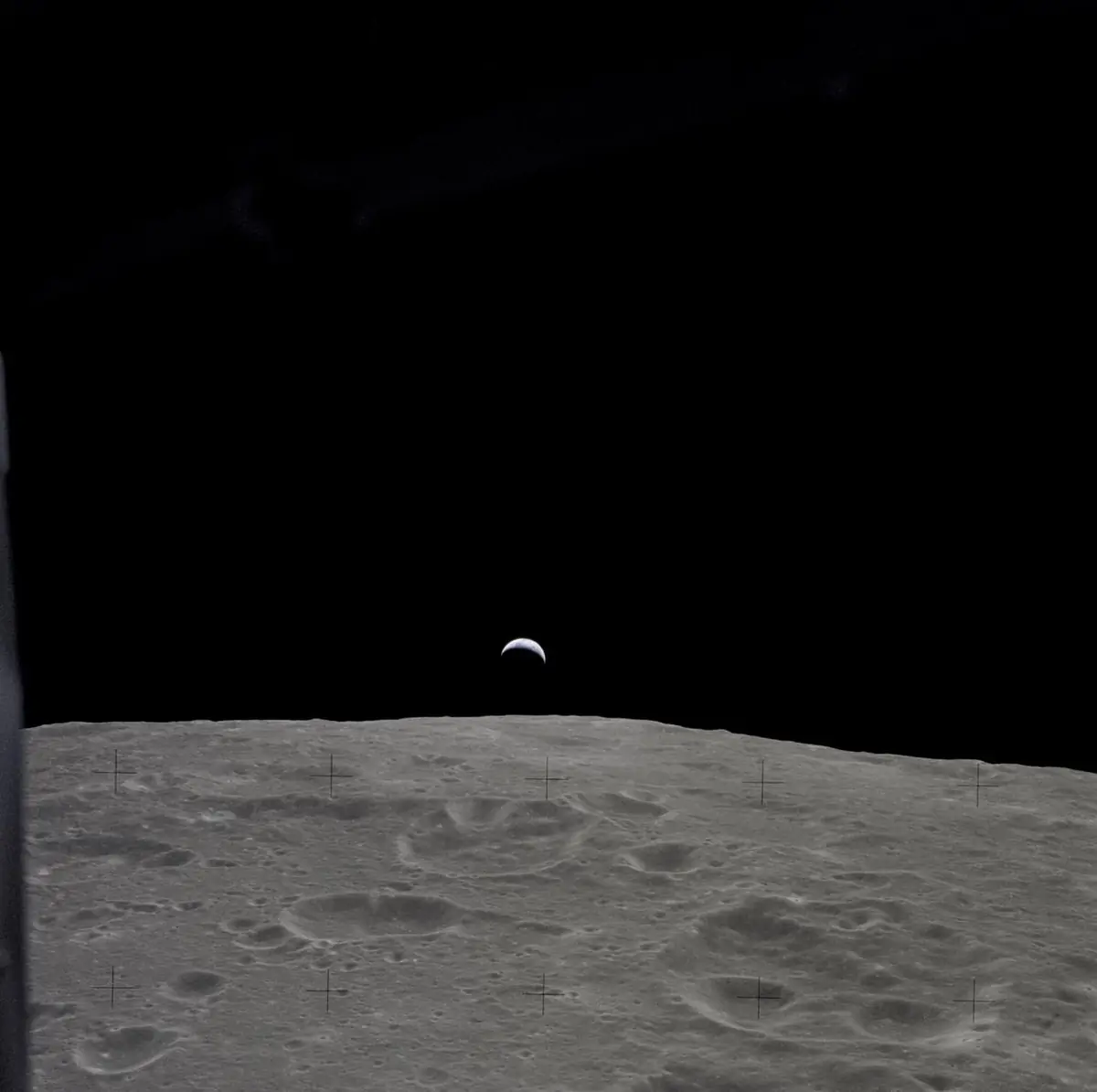
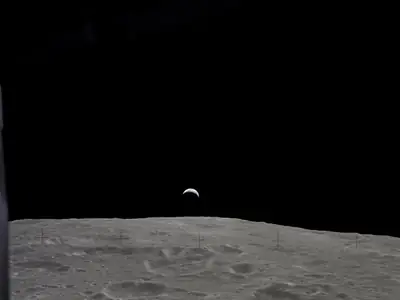 A partly lit Earth rises over the lunar horizon.
-
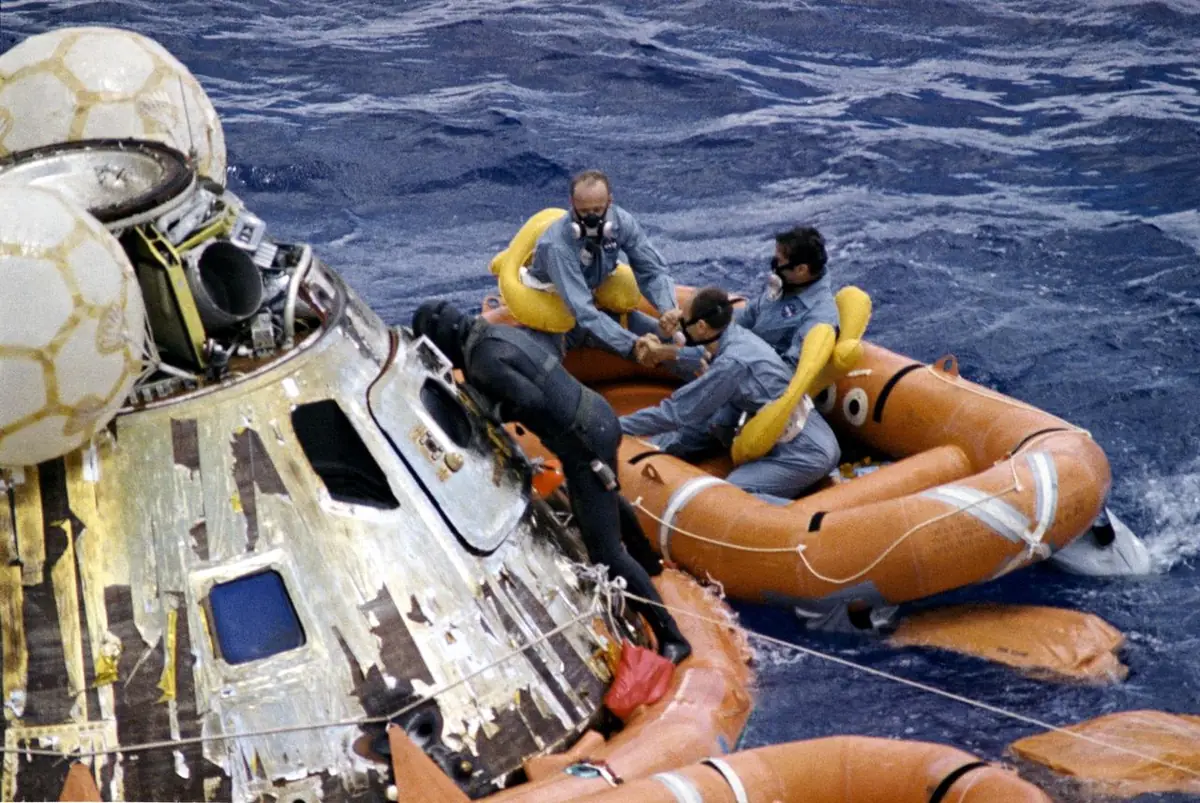
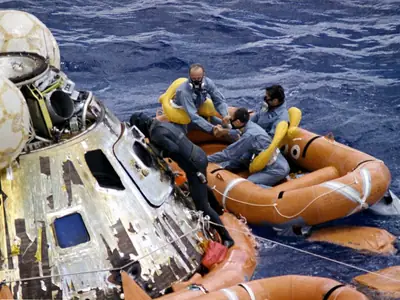 A Navy swimmer helps the crew from Yankee Clipper into the raft.
At a glance 13
-
Mission type
Type H-1: a precision landing demonstration and the first systematic exploration of a landing site, with the first full ALSEP.
-
Dates
Launched 14 November 1969, landed 19 November, splashed down 24 November 1969.
-
Mission duration
244 h 36 min 25 s (10 days 4 h 36 min).
-
Call signs
Command module Yankee Clipper (CM-108) and lunar module Intrepid (LM-6).
-
Landing site
Eastern Oceanus Procellarum (Ocean of Storms), on the rim area of Surveyor crater, beside the robotic Surveyor 3 lander.
-
Coordinates
3.01239° S, 23.42157° W.
-
Precision
Intrepid landed 163 m535 feet from Surveyor 3, proving the pinpoint landing needed for rougher sites.
-
Time on the Moon
31 h 31 min 12 s on the surface.
-
Moonwalks
Two EVAs, totalling 7 h 45 min 18 s.
-
Samples
34.35 kg (75.7 lb) of rock and soil.
-
Lunar orbits
45 orbits, 88 h 58 min in lunar orbit.
-
All Navy
Conrad, Gordon and Bean were all U.S. Navy officers; the backup crew was all Air Force.
-
Designations
AS-507, Eastern Test Range #2793; international IDs 1969-099A to -099D.
Crew & team 12
-
Pete Conrad, commander
Cdr., USN, born 2 June 1930 in Philadelphia; 39 at launch. Princeton aeronautical engineering (1953), selected 1962. Pilot of Gemini 5 and command pilot of Gemini 11; Apollo 12 was his third flight.
-
Conrad later
Commanded Skylab 2 in 1973, the first crew to live on America's first space station. He died on 8 July 1999 after a motorcycle accident in Ojai, California.
-
Dick Gordon, command module pilot
Cdr., USN, born 5 October 1929 in Seattle, Washington; 40 at launch. B.S. in chemistry from the University of Washington (1951), selected 1963, pilot of Gemini 11.
-
Gordon's lost Moon landing
He was backup commander for Apollo 15 and in line to command Apollo 18 before the flight was cancelled. He never walked on the Moon.
-
Alan Bean, lunar module pilot
Cdr., USN, born 15 March 1932 in Wheeler, Texas; 37 at launch. University of Texas aeronautical engineering (1955), selected 1963. Apollo 12 was his first flight.
-
Bean later
Commanded Skylab 3 in 1973, then left NASA in 1981 to paint the Apollo story full-time. He died in 2018.
-
Backup crew
Dave Scott, Al Worden and Jim Irwin, who flew Apollo 15 together.
-
Support crew
Gerald Carr, Paul Weitz and Ed Gibson, all later Skylab astronauts.
-
Capsule communicators
Gerald Carr, Ed Gibson, Paul Weitz, Don Lind, Dave Scott, Al Worden and Jim Irwin, plus civilian backup CAPCOMs Dickie Warren, James Rippey, James Lewis and Michael Wash.
-
Flight directors
Four shifts: Gerry Griffin, Pete Frank, Cliff Charlesworth and Milt Windler.
-
Weights
On launch day Conrad weighed 67.7 kg, Gordon 70.4 kg and Bean 69.1 kg; Bean came home 5.6 kg lighter.
-
Checklist pranks
The backup crew slipped cartoons and pin-up photos into the cuff checklists the moonwalkers wore on their wrists.
Launch & Saturn V 11
-
Liftoff
16:22:00 GMT (11:22 a.m. EST) on 14 November 1969 from Pad 39A, with President Nixon watching.
-
Rain and overcast
20.0 °C68.0 °F, 92% humidity, 100% stratocumulus at 640 m2,100 feet, visibility 6 km3.7 miles. It was the first Saturn launched in rain.
-
Lightning, twice
At 36.5 s, 1,830 m6,000 feet up, the Saturn V triggered a lightning strike, and a second discharge followed at 52 s. Fuel cells dropped off line and warning lights filled the panel.
-
“SCE to Aux”
Flight controller John Aaron recognized the garbled telemetry and called for the Signal Conditioning Equipment to be switched to auxiliary. Bean found the switch and the data came back.
-
Self-triggered
Analysis showed the rocket and its exhaust plume triggered the strike. It did not fly through a thunderstorm, so launch rule 1-404 had not been broken.
-
Unscathed Saturn
The launch vehicle's own systems and guidance were unaffected; spacecraft systems were checked with extra care in Earth orbit.
-
Borrowed tank
Two days before launch a leaking hydrogen tank in the service module was swapped for one from the Apollo 13 spacecraft.
-
Weight at ignition
6,487,742 lb (2,943 t) for SA-507.
-
Ascent
Flight azimuth 72.029°; maximum dynamic pressure 682.95 lb/ft² at 81.1 s. Parking orbit 100.1 × 97.8 n mi (185 × 181 km115 × 113 miles) at 32.540°.
-
Translunar injection
A 341.24-s S-IVB burn from 2:47:23 sent them toward the Moon after 1.5 Earth orbits.
-
Spent stages
S-IC impact 365 n mi (676 km420 miles) downrange; S-II impact 2,404 n mi (4,452 km2,766 miles) downrange in the Atlantic.
Spacecraft 8
-
Command & service module
CSM-108, 63,559 lb at launch; service module 51,105 lb fuelled, command module 12,365 lb dry.
-
Intrepid
LM-6, 33,562 lb at launch. Descent stage dry weight 4,875 lb.
-
Descent propellant
18,429 lb loaded, 17,254 lb burned, leaving about 103 s of hover time at touchdown.
-
Software
Colossus 2C in the command module, Luminary 1B in the lunar module.
-
Color TV camera
The first color TV camera on the lunar surface. It was ruined early in the first moonwalk when it was pointed at the Sun.
-
Nuclear power
The ALSEP ran on a SNAP-27 radioisotope thermoelectric generator, fuelled by a plutonium-238 capsule carried in a cask on the LM's leg, giving about 70 W.
-
Hybrid trajectory
First Apollo to leave free return on purpose: a hybrid profile that allowed daylight launch and landings at more sites.
-
Two LMs on the Moon
Intrepid's descent stage stands about 163 m535 feet from Surveyor 3, the only place where a crewed lander sits beside an earlier robotic one.
Flight & orbit 11
-
Docking on TV
Transposition and docking was televised: separation at 3:18:05, docked at 3:26:53, ejected at 4:13:01.
-
Early LM check
Because of the lightning, Conrad and Bean entered Intrepid early at 7:20 to check it. All systems were fine.
-
Leaving free return
A 9.19-s, 61.8 ft/s correction at 30:52:44 put the spacecraft on the hybrid non-free-return path.
-
Lunar orbit insertion
A 352.25-s SPS burn at 83:25:23 gave a 168.8 × 62.6 n mi (313 × 116 km194 × 72 miles) orbit; the coast had taken 80 h 38 min.
-
Descent
Undocked at 107:54:02; descent orbit insertion at 109:23:40; powered descent began at 110:20:38 and lasted 717 s.
-
Lunar liftoff
14:25:47 GMT on 20 November after 31.5 h on the surface; a 423-s burn reached a 46.3 × 8.8 n mi (86 × 16 km53 × 10 miles) orbit.
-
Rendezvous
Docked with Yankee Clipper at 145:36:20 after 37 h 42 min apart.
-
A deliberate crash
After jettison, Intrepid's ascent stage was fired into the Moon at 149:55:16, about 76 km47 miles east-southeast of the landing site.
-
Stray S-IVB
A long ullage burn left the S-IVB without enough energy to escape, so it stayed in a distant orbit around Earth and Moon.
-
J002E3
In 2002 an amateur astronomer found a new object orbiting Earth. Its orbit and titanium-white paint spectrum point to Apollo 12's S-IVB, briefly recaptured.
-
Trans-Earth injection
A 130.32-s burn at 172:27:17 after 45 orbits.
Landing site 9
-
Touchdown
06:54:36 GMT (1:54:36 a.m. EST) on 19 November 1969.
-
“Pete's Parking Lot”
The planned touchdown area was a smooth patch nicknamed Pete's Parking Lot near the Snowman, a pattern of craters used for recognition.
-
Into the dust
Blowing dust hid the surface in the last seconds and Conrad landed mostly on instruments, about 8 m25 feet from the lip of a crater.
-
Fuel margin
About 103 s of hover time remained.
-
Sun angle
Just 5.1°, the lowest landing Sun angle of any Apollo landing.
-
Attitude
Intrepid rested 3° pitched up and rolled 3.8° left.
-
Mare site with a ray
A mare basalt plain crossed by a bright ray from Copernicus, about 390 km240 miles to the north.
-
Named craters
The traverse visited Head, Bench, Sharp, Halo, Surveyor and Middle Crescent craters.
-
Surveyor 3
The robotic lander touched down on 20 April 1967 and had sat for 31 months when the astronauts reached it.
Moonwalks 10
-
“Whoopie!”
Conrad, at 1.68 m5 feet 6 inches one of the shorter astronauts, stepped down saying: “Whoopie! Man, that may have been a small one for Neil, but that's a long one for me.”
-
EVA-1
3 h 56 min 3 s. They deployed the S-band antenna, the solar wind sail, the flag and the ALSEP, walking about 1 km0.6 miles and collecting 16.7 kg.
-
Stuck fuel element
The RTG fuel element would not come out of its cask until Conrad hit it with a hammer.
-
ALSEP site
Set up about 180–210 m600–700 feet northwest of the LM. The seismometer recorded their footsteps on the walk back.
-
EVA-2
3 h 49 min 15 s. A loop around Head, Bench, Sharp and Halo craters to Surveyor 3, about 1.3 km0.8 miles, with 17.6 kg of samples.
-
Visiting Surveyor 3
They cut off its TV camera, sample scoop, cables and tubing. Its footpad prints were still crisp, and the spacecraft had turned tan from dust.
-
Rolling a rock
Conrad rolled a grapefruit-sized rock down Head crater about 100 m330 feet from the seismometer. It registered nothing.
-
The self-timer prank
They smuggled a camera self-timer to take a picture of both of them with Surveyor. It stayed lost in a tool bag until it was too late.
-
Totals
7 h 45 min 18 s outside, about 2.3 km1.4 miles walked, farthest point about 410 m1,350 feet from Intrepid.
-
Dust
Their suits ended up grey with dust, and they brushed each other off before climbing back in.
Surface science 10
-
First ALSEP
Passive seismometer, lunar surface magnetometer, solar wind spectrometer, suprathermal ion detector and cold cathode ion gauge, plus a dust detector, all wired to a central station.
-
Ringing like a bell
When Intrepid's ascent stage hit the Moon, the seismometer recorded vibrations for more than 55 minutes. The dry, fractured crust barely damped them.
-
Long life
The Apollo 12 station sent data until all ALSEPs were switched off on 30 September 1977.
-
Magnetic surprise
The magnetometer found a steady local field of about 38 nanotesla, evidence that lunar rocks carry fossil magnetism.
-
Solar wind at the surface
The spectrometer showed solar-wind plasma reaching the surface unchanged from what nearby satellites measured.
-
Suit outgassing
The cold cathode gauge read a higher “atmosphere” whenever Conrad came close, from gas leaking out of his suit.
-
Solar wind sail
Exposed for 18 h 42 min, far longer than on Apollo 11.
-
Surveyor hardware
The returned parts showed how materials age after 31 months on the Moon. The camera is now at the National Air and Space Museum.
-
The bacteria question
Streptococcus bacteria were reported inside the Surveyor camera; later reviews concluded they most likely came from contamination after return.
-
Close-up camera
A stereo close-up camera photographed soil grains near the LM in the last minutes outside.
Rocks & discoveries 7
-
What came home
34.35 kg, including core samples (two single and one double), an 8-in trench sample and special environmental samples.
-
Younger lava
The basalts are roughly 3.1–3.3 billion years old, younger than Apollo 11's, with less titanium and more olivine.
-
KREEP
Some soils and rocks were rich in potassium (K), rare earth elements (REE) and phosphorus (P). The name KREEP was coined for this signature.
-
Dating Copernicus
Ray material in the soil is interpreted as ejecta from Copernicus, giving that crater an age of about 800 million years.
-
Sample numbers
Apollo 12 samples are numbered 12xxx.
-
Soil colour
The crew noted the soil grew lighter in colour as they dug deeper.
-
Bedrock and glass
Assorted rocks, bedrock, glass and “molten” samples were collected on the traverse.
Alone in orbit 7
-
Gordon solo
Dick Gordon flew Yankee Clipper alone for 37 h 42 min.
-
Seeing the landers
Gordon spotted both Surveyor 3 and Intrepid from orbit through the sextant, and Conrad saw the CSM pass overhead.
-
Multispectral photography
Gordon ran experiment S-158, photographing the Moon through colour filters to map composition.
-
Scouting future sites
He photographed Fra Mauro and Descartes, the future Apollo 14 and 16 sites, plus the wall of Theophilus.
-
A wrong target
One set of high-resolution photos caught crater Herschel instead of Lalande, a crew error noted in the mission report.
-
Plane changes
The CSM made plane changes at 119:47 and 159:05 to line up rendezvous and site photography.
-
Gemini 11 record
Conrad and Gordon had set the Gemini altitude record of about 1,370 km850 miles on Gemini 11 in 1966.
Return & recovery 9
-
Entry
Entry at 36,116 ft/s; peak load 6.57 g.
-
Hard splashdown
Rough seas made the splashdown very hard, about 15 g. A 16 mm camera broke loose and hit Bean above the right eye.
-
Splashdown
20:58:25 GMT on 24 November 1969 at 15.78° S, 165.15° W, about 2 n mi (3.7 km2.3 miles) from target and 3.9 n mi (7.2 km4.5 miles) from USS Hornet.
-
Righted
The capsule floated apex-down and was righted in 4 min 26 s.
-
Same ship
USS Hornet (CVS-12), Capt. Carl J. Seiberlich, recovered both of the first two landing crews.
-
Quarantine
Crew aboard in 60 minutes, then the Mobile Quarantine Facility and the Lunar Receiving Laboratory. Released on 10 December 1969.
-
Lost service module
The service module was never seen after separation and probably burned up rather than skipping into its planned high orbit.
-
Recovery force
5 ships and 26 aircraft.
-
Where Yankee Clipper is
Displayed at the Virginia Air & Space Science Center in Hampton, Virginia.
Moments & legacy 6
-
Lightning rules
Apollo 12 changed launch weather rules for good: later flights avoided launching through clouds that could trigger lightning.
-
The patch
A clipper ship sails over the Ocean of Storms in Navy blue and gold. Its four stars stand for the crew and Clifton C. Williams, who died in a 1967 jet crash and would have flown as lunar module pilot.
-
Bean the painter
Bean painted the Apollo missions for decades, mixing tiny amounts of Moon dust from his mission patches into some paintings.
-
Only visit to a robot
Apollo 12 is still the only time humans have walked up to a spacecraft that landed before them on another world.
-
From orbit today
LRO images show Surveyor 3, Intrepid's descent stage and the astronauts' foot trails between them.
-
Seismic yardstick
The ascent-stage crash gave seismologists their first known-source moonquake to calibrate against.
Seven missions side by side
Figures from NASA's Apollo by the Numbers. Select a mission to open its dossier.
| Measure | Apollo 11 | Apollo 12 | Apollo 13 | Apollo 14 | Apollo 15 | Apollo 16 | Apollo 17 |
|---|---|---|---|---|---|---|---|
| Landing (UTC) | 20 July 1969 | 19 November 1969 | did not land | 5 February 1971 | 30 July 1971 | 21 April 1972 | 11 December 1972 |
| Landing site | Mare Tranquillitatis | Oceanus Procellarum | Fra Mauro highlands (planned) | Fra Mauro highlands | Hadley–Apennine | Descartes Highlands | Taurus–Littrow valley |
| Lunar module | Eagle (LM-5) | Intrepid (LM-6) | Aquarius (LM-7) | Antares (LM-8) | Falcon (LM-10) | Orion (LM-11) | Challenger (LM-12) |
| Command module | Columbia (CM-107) | Yankee Clipper (CM-108) | Odyssey (CM-109) | Kitty Hawk (CM-110) | Endeavour (CM-112) | Casper (CM-113) | America (CM-114) |
| Commander | Neil Armstrong | Pete Conrad | Jim Lovell | Alan Shepard | David Scott | John Young | Gene Cernan |
| Lunar module pilot | Buzz Aldrin | Alan Bean | Fred Haise | Edgar Mitchell | Jim Irwin | Charlie Duke | Harrison Schmitt |
| Command module pilot | Michael Collins | Dick Gordon | Jack Swigert | Stuart Roosa | Al Worden | Ken Mattingly | Ron Evans |
| Mission type | G | H-1 | H-2 | H-3 | J-1 | J-2 | J-3 |
| Time on the Moon | 21 h 36 min | 31 h 31 min | none | 33 h 30 min | 66 h 54 min | 71 h 2 min | 74 h 59 min |
| Moonwalks | 1 · 2 h 31 min | 2 · 7 h 45 min | none | 2 · 9 h 22 min | 3 · 18 h 34 min | 3 · 20 h 14 min | 3 · 22 h 3 min |
| Samples | 21.55 kg | 34.35 kg | none | 42.28 kg | 77.31 kg | 95.71 kg | 110.52 kg |
| Farthest from the lunar module | 60 m200 feet | ≈ 410 m1,350 feet | none | ≈ 1.45 km0.9 miles | ≈ 5.0 km3.1 miles | ≈ 4.6 km2.9 miles | ≈ 7.6 km4.7 miles |
| Rover distance | none | none | none | none | 27.9 km17.3 miles | 26.9 km16.7 miles | 35.7 km22.2 miles |
| Sun at landing | 10.8° | 5.1° | none | 10.3° | 12.2° | 14.8° | 13.0° |
| Lunar orbits | 30 | 45 | none (flyby) | 34 | 74 | 64 | 75 |
| Mission length | 8 d 3 h 18 min | 10 d 4 h 36 min | 5 d 22 h 54 min | 9 d 0 h 1 min | 12 d 7 h 11 min | 11 d 1 h 51 min | 12 d 13 h 51 min |
| Recovery ship | USS Hornet | USS Hornet | USS Iwo Jima | USS New Orleans | USS Okinawa | USS Ticonderoga | USS Ticonderoga |
| Sourced facts | 130 | 113 | 134 | 112 | 110 | 111 | 112 |
Sources and method
27 sources, how the Moon is drawn, and photo credits
Source
Apollo Preliminary Science Reports, NASA SP-214, SP-235, SP-272, SP-289, SP-315, SP-330
All sourcesSource
A. Saunders, The Mystery Behind Alan Shepard's 'Moon Shot' Revealed, USGA, Feb 2021
All sourcesSource
All sourcesSource
NASA/JPL, First Confirmed Capture into Earth Orbit Is Likely Apollo Rocket (2002)
All sourcesSource
NASA History, 50 Years Ago: Apollo 13 Review Board Report (on the Cortright report, June 1970)
All sourcesSource
NASA, Acting NASA Administrator Reflects on Legacy of Astronaut Jim Lovell, Aug 2025
All sourcesSource
All sources