
Apollo landing sites
Apollo on tonight's Moon Apollo on the Moon of
The six landing sites, and Apollo 13's planned one, placed on the Moon as it looks from where you are. Each pin is in sunlight or lunar night the way the site is right now. Pick a site for its mission dossier.
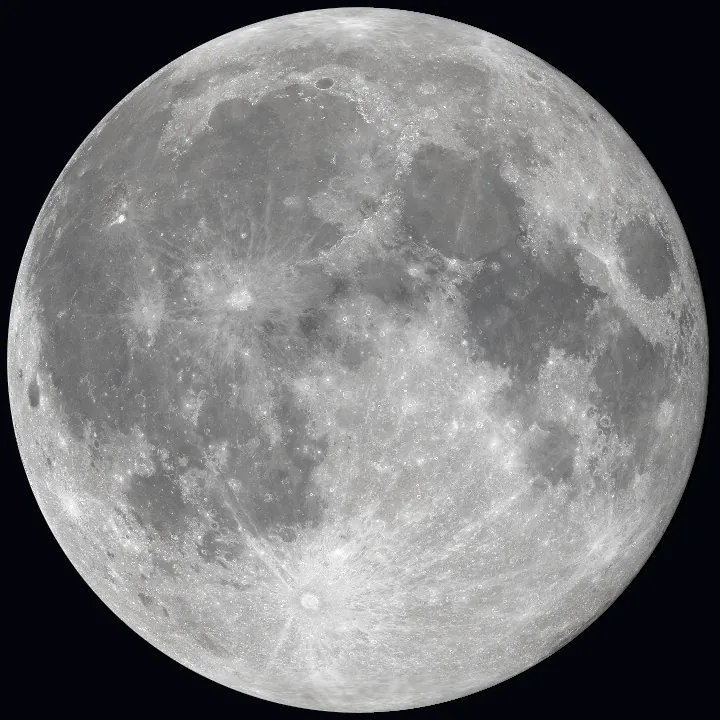
Site in sunlightSite in lunar nightPlanned, never reached
Clear-sky view: clouds and weather are not shown. Rendered from NASA Lunar Reconnaissance Orbiter maps.
The near side face on, north up, as at full Moon. With JavaScript on, this shows the Moon as it looks from your location right now.
Apollo 16
Apollo 16
Cayley Plains, Descartes Highlands, Descartes Highlands · 8.973° S, 15.500° E
- Commander
- John W. Young
- Command module pilot
- Thomas K. “Ken” Mattingly II
- Lunar module pilot
- Charles M. Duke Jr.
- Command module
- Casper
- Lunar module
- Orion
The only landing in the central highlands, where expected volcanic rock turned out to be impact breccia.
- Landed
- 21 April 197202:23 UTC
- Time on the Moon
- 71 h 2 minliftoff 24 April 1972
- Moonwalks
- 20 h 14 min3 moonwalks · 26.9 km16.7 miles by rover
- Samples
- 95.71 kg211.0 lb
- Farthest from the lunar module
- ≈ 4.6 km2.9 milesby Lunar Roving Vehicle
- Mission
- 11 d 1 h 51 min64 lunar orbits · USS Ticonderoga
-
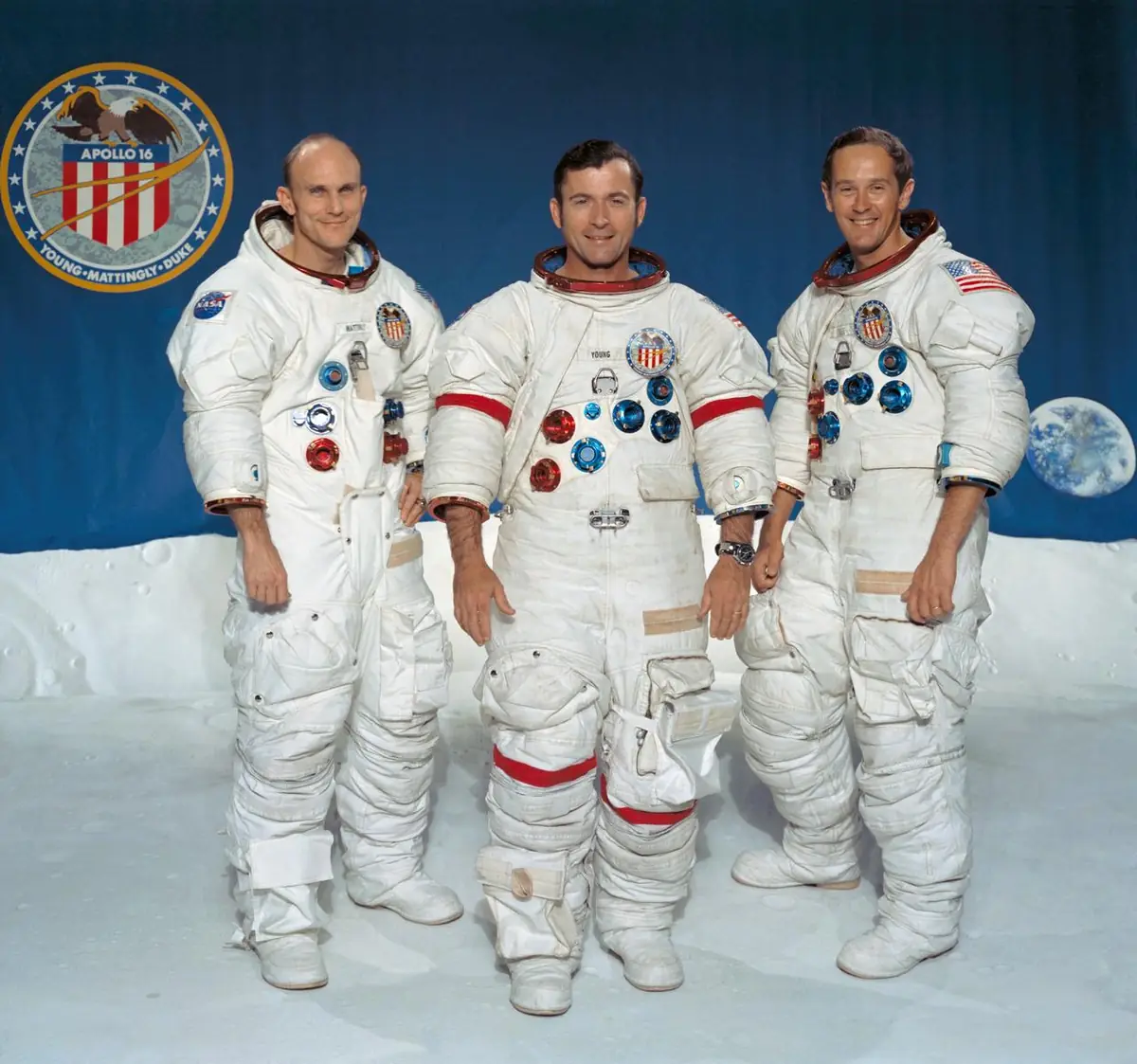
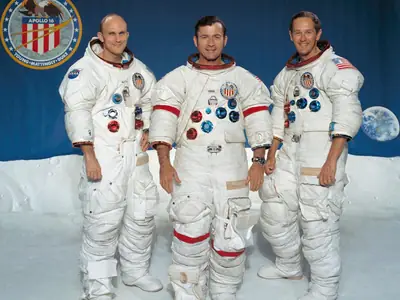 Prime crew portrait: Ken Mattingly, John Young and Charlie Duke.
-
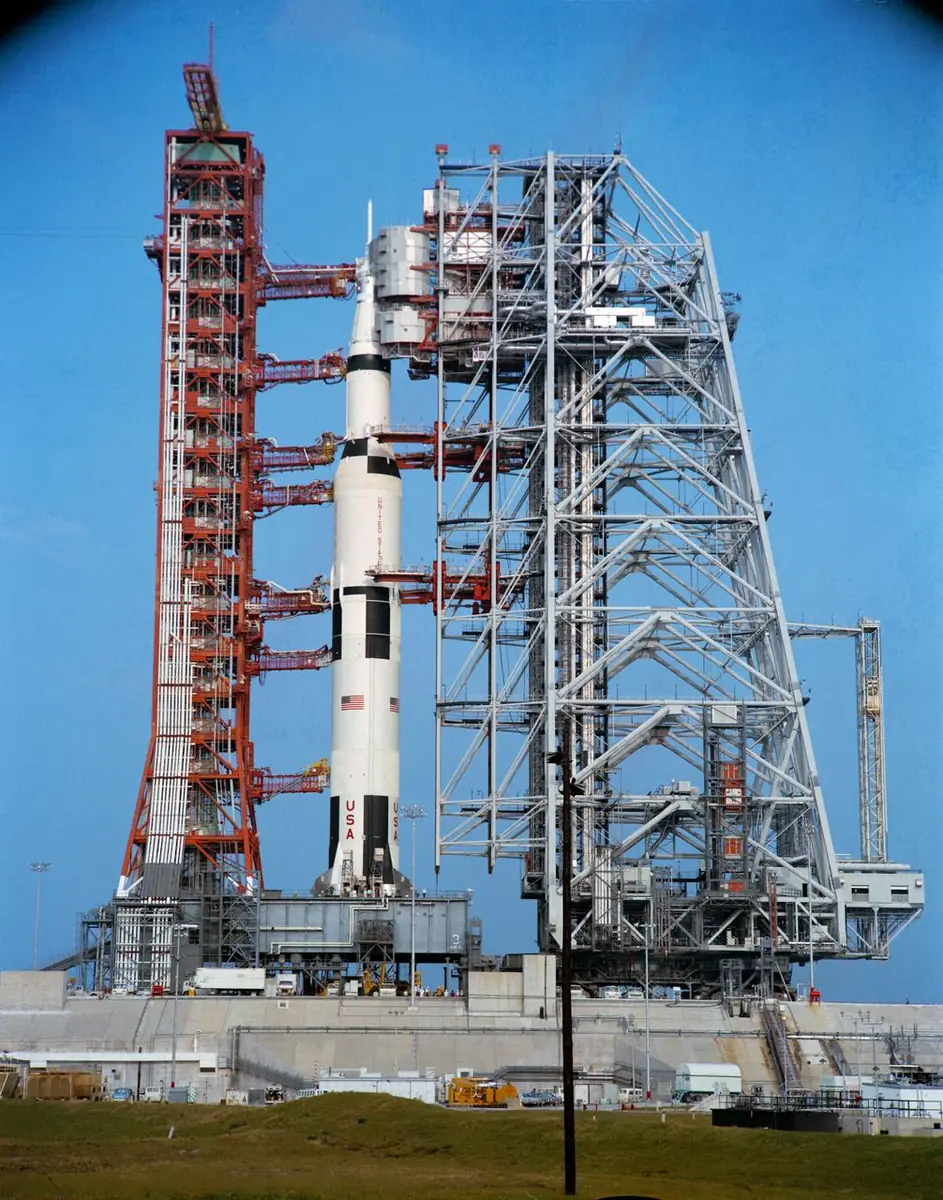
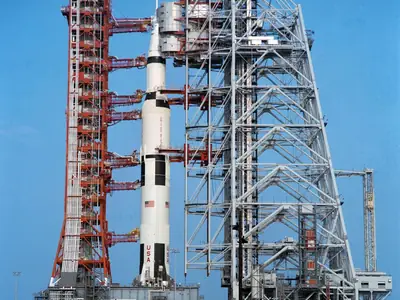 Apollo 16 on Pad 39A before launch.
-
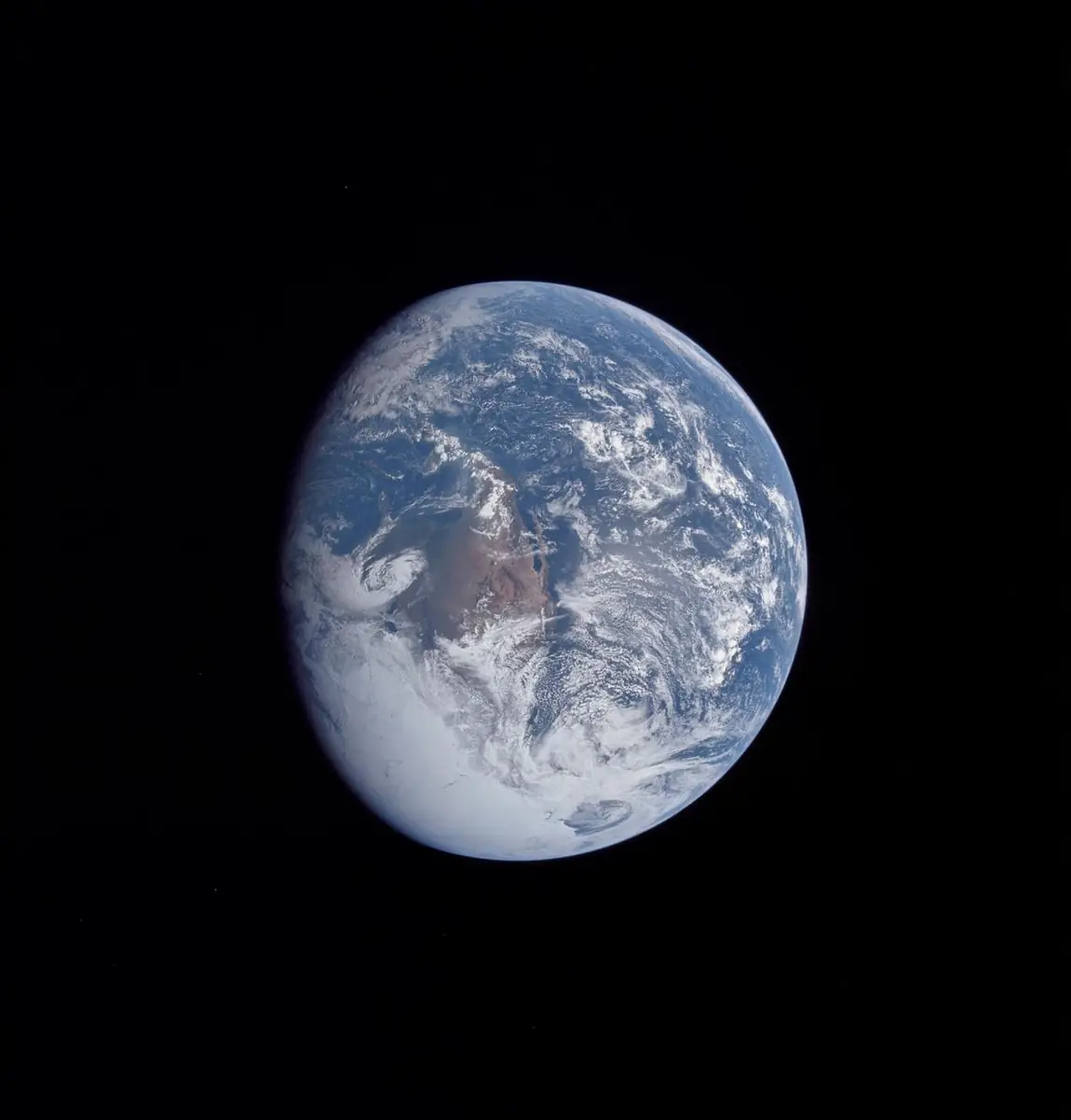
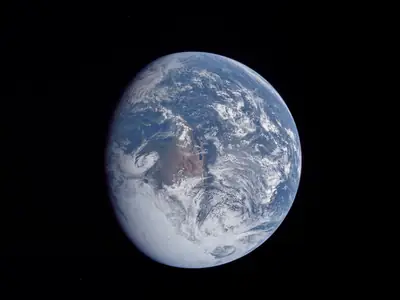 Earth about 1.5 hours after translunar injection.
-
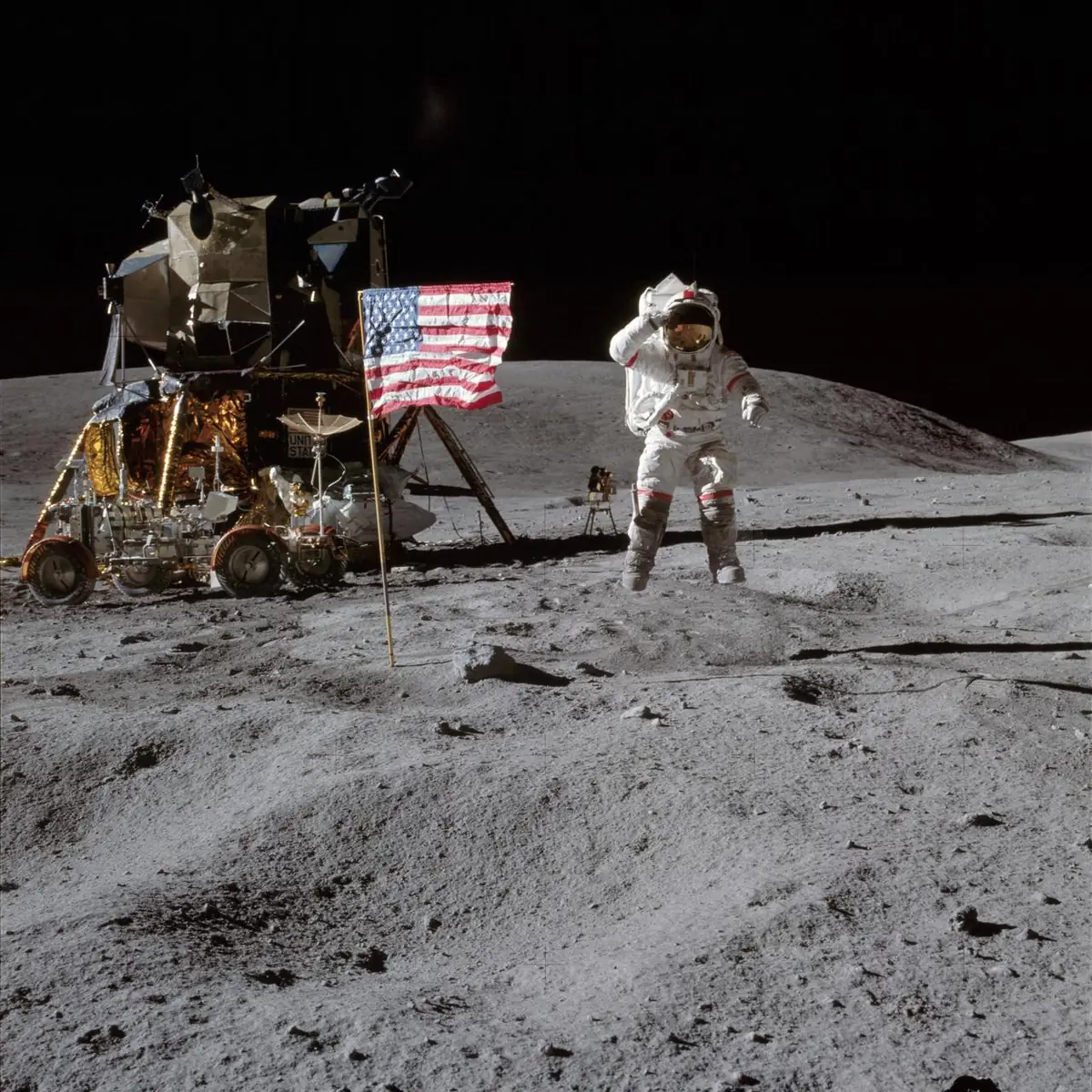
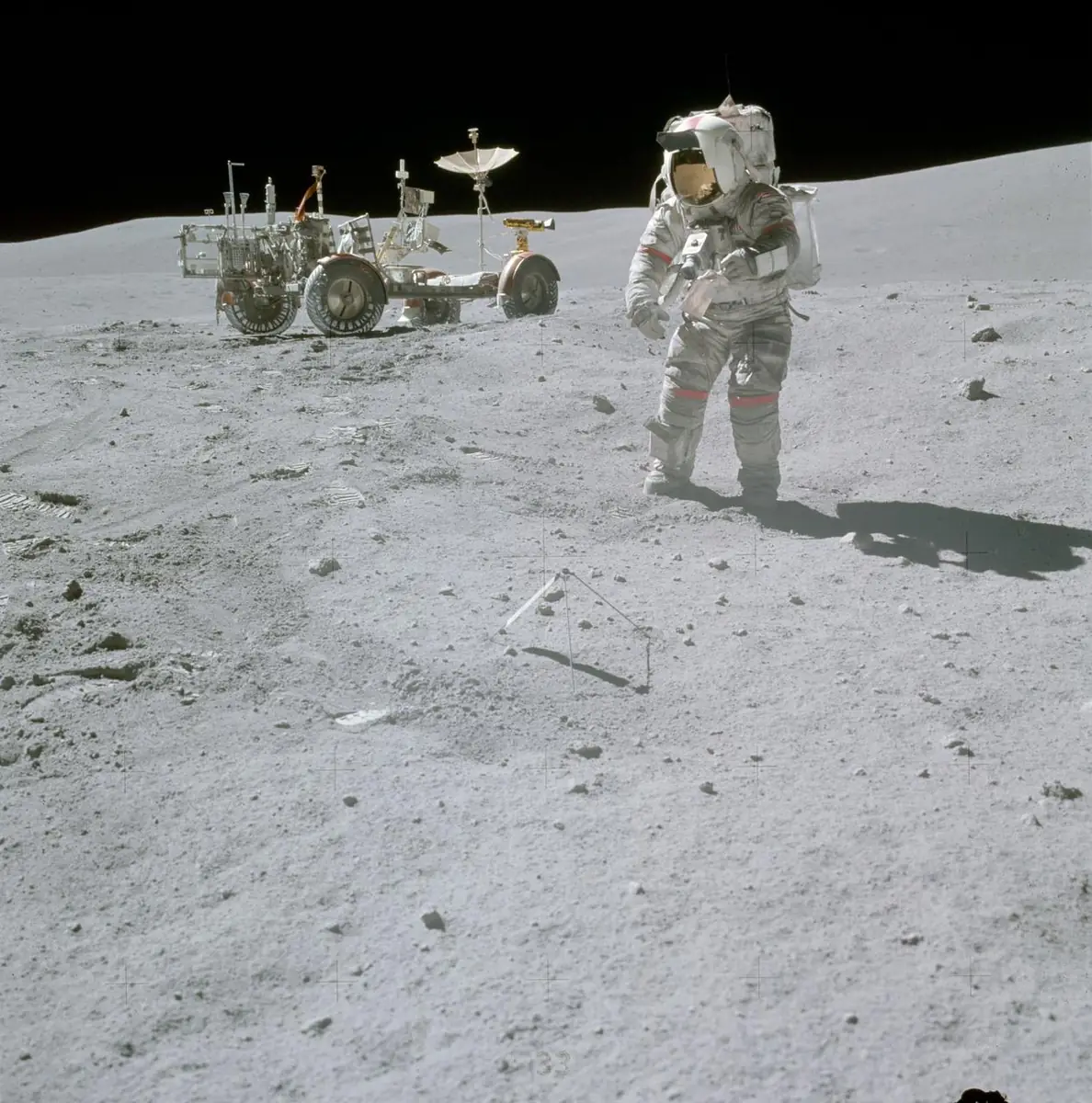
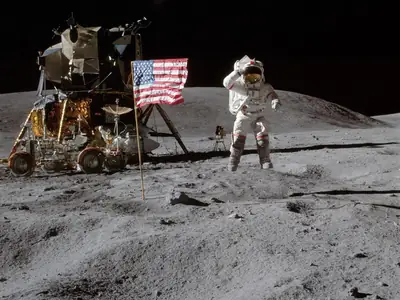 Young leaps off the ground saluting the flag; Orion and the rover behind.
-
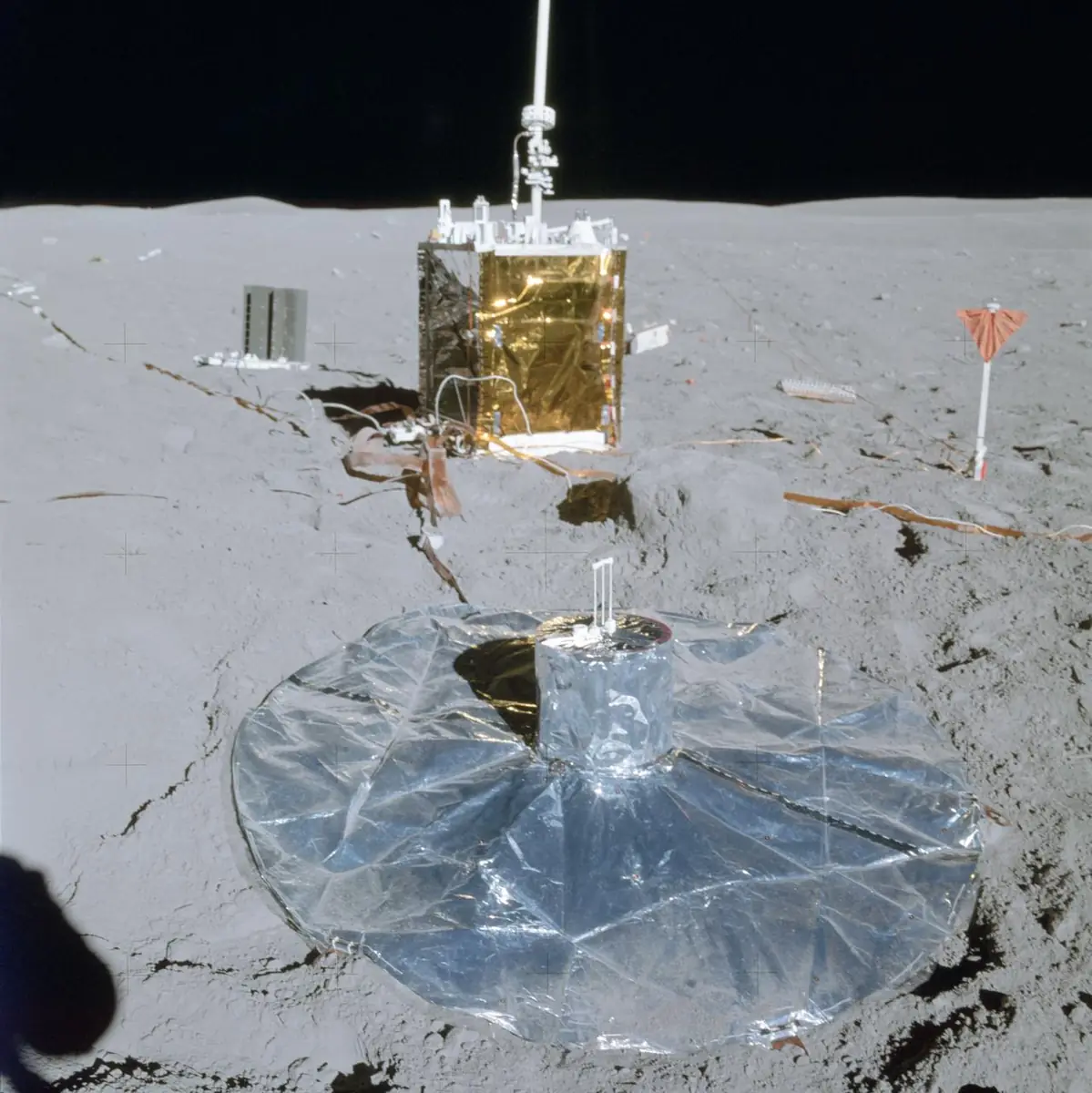
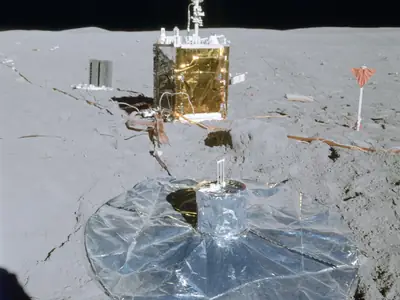 The ALSEP deployed on the Cayley Plains.
-
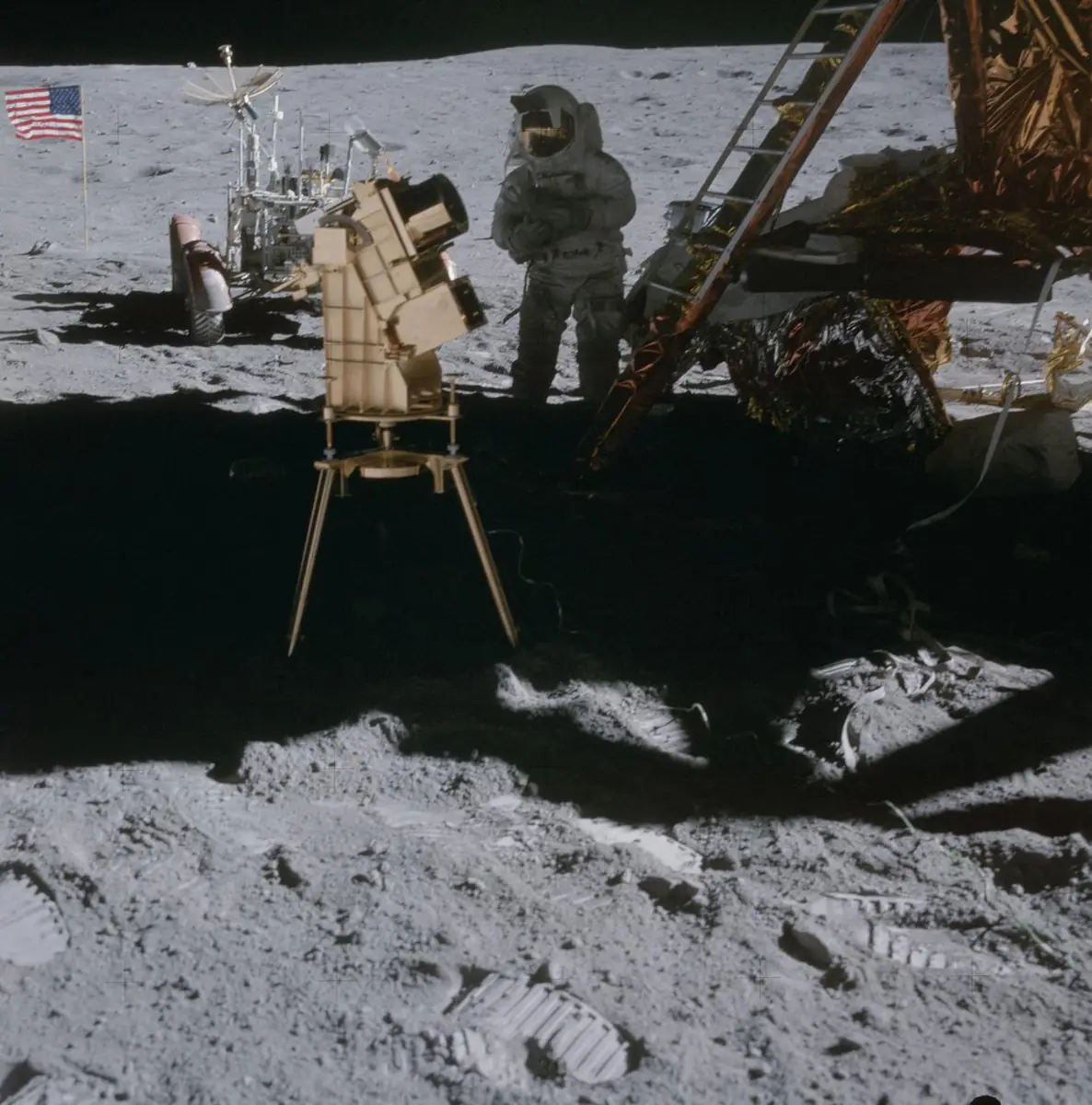
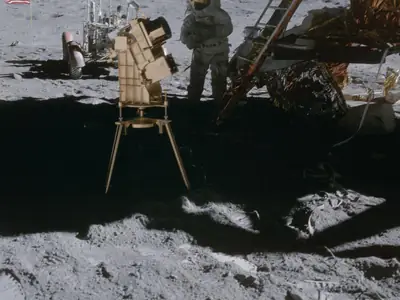 Duke in Orion's shadow behind the gold far-ultraviolet camera.
-
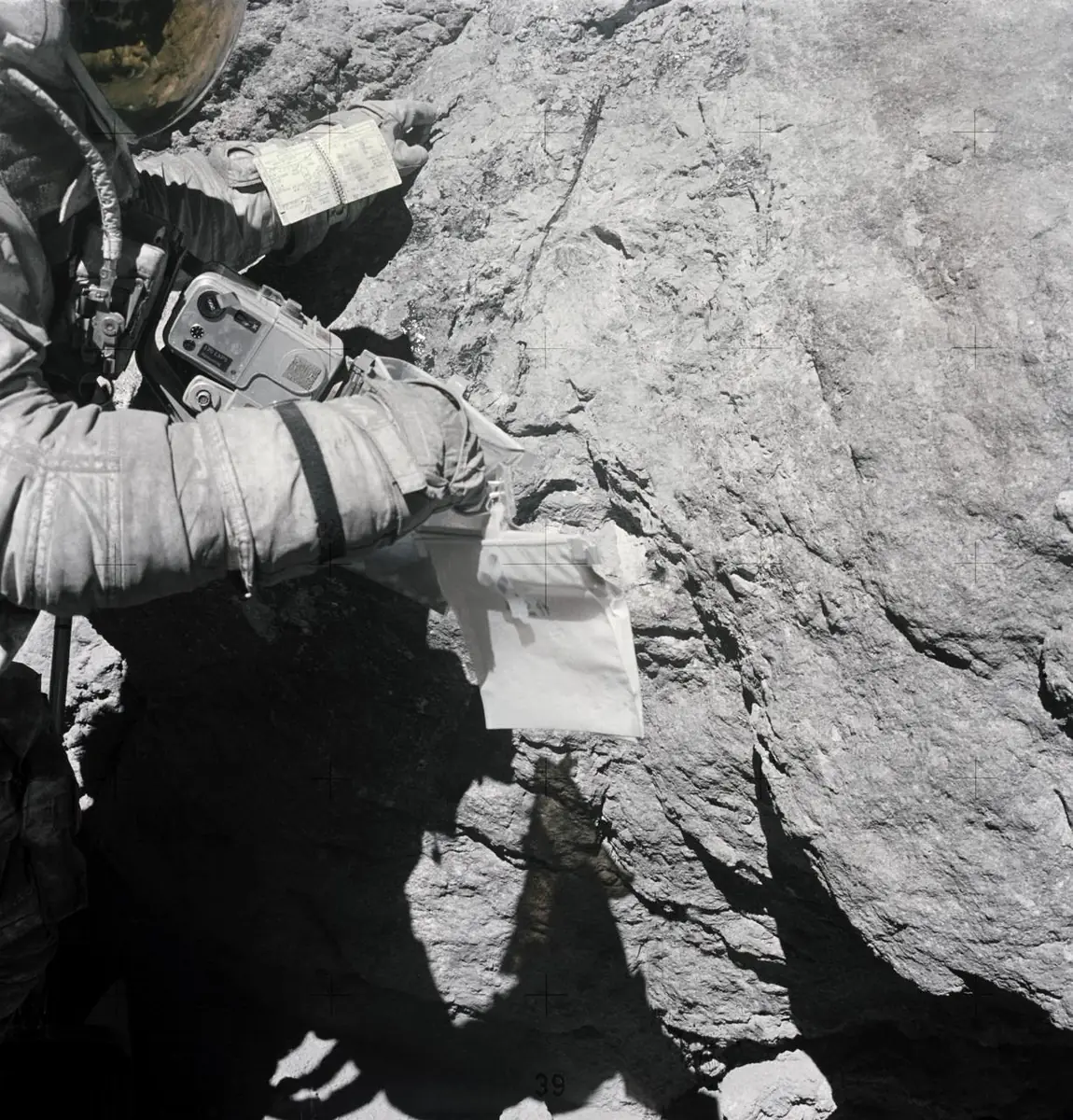
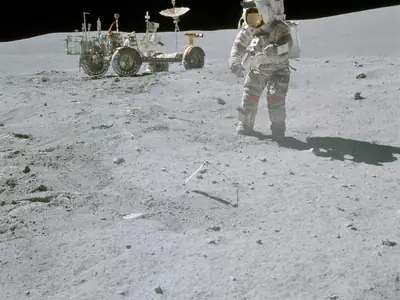 Young, his suit grey with dust, sampling at North Ray crater.
-
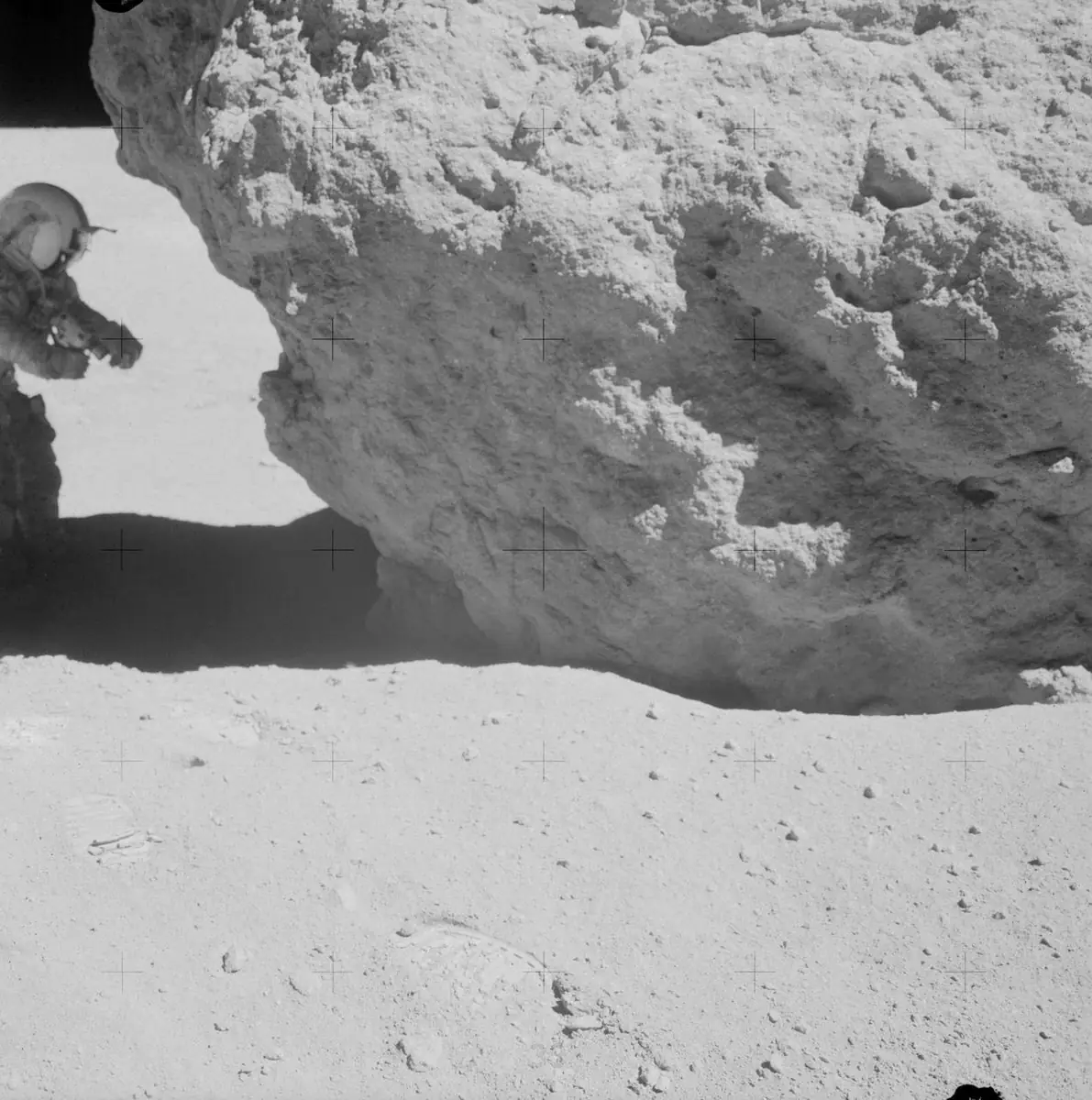
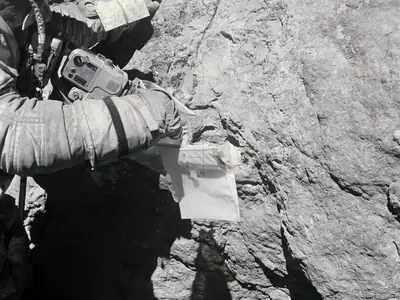 Duke examines a huge boulder at North Ray crater.
-
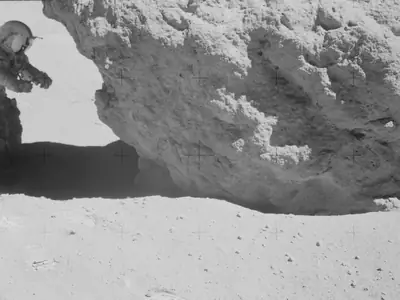 Young beside Shadow Rock at Station 13.
-
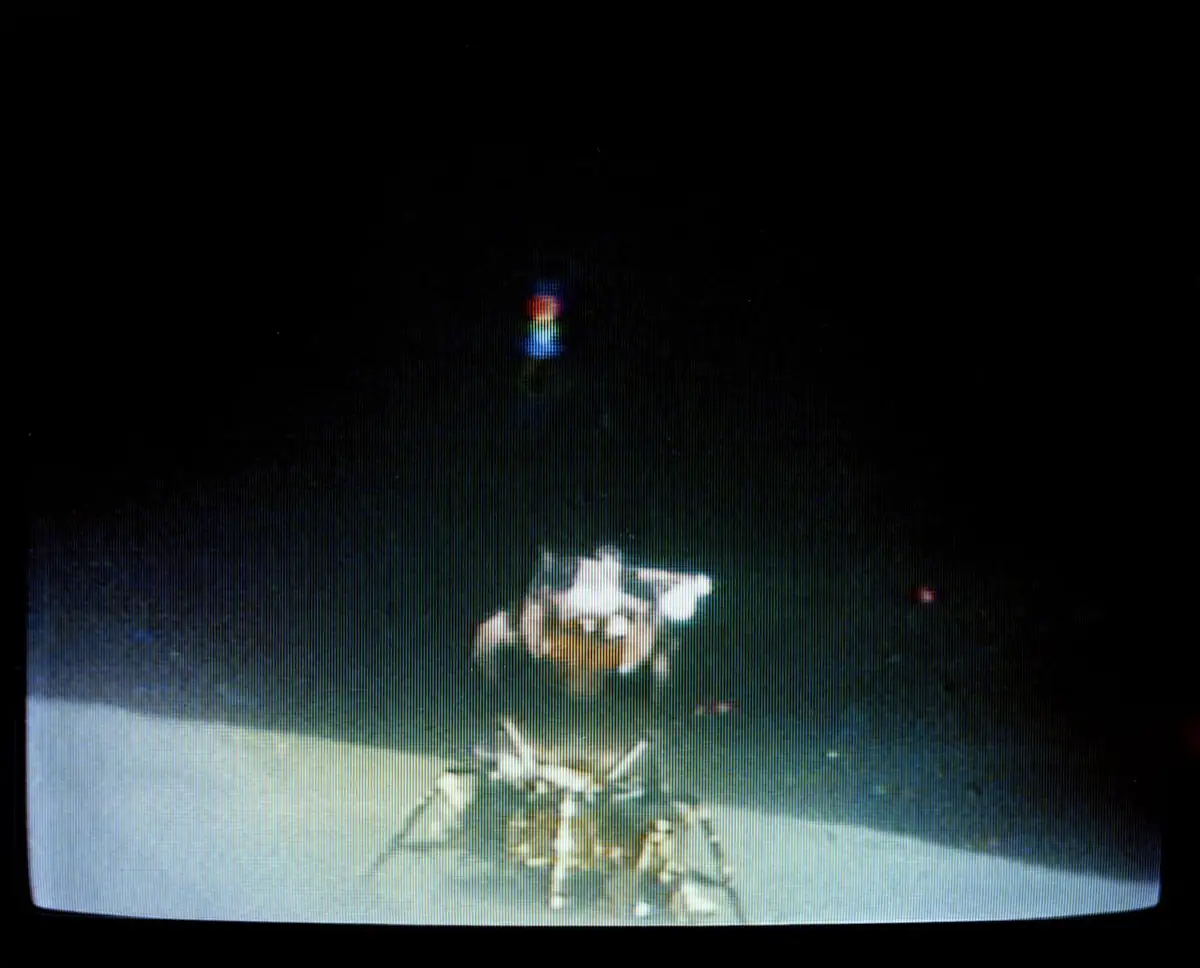
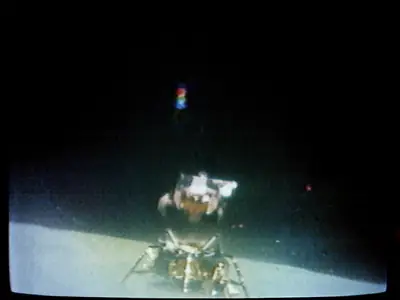 TV from the rover: Orion's ascent stage lifts off.
-
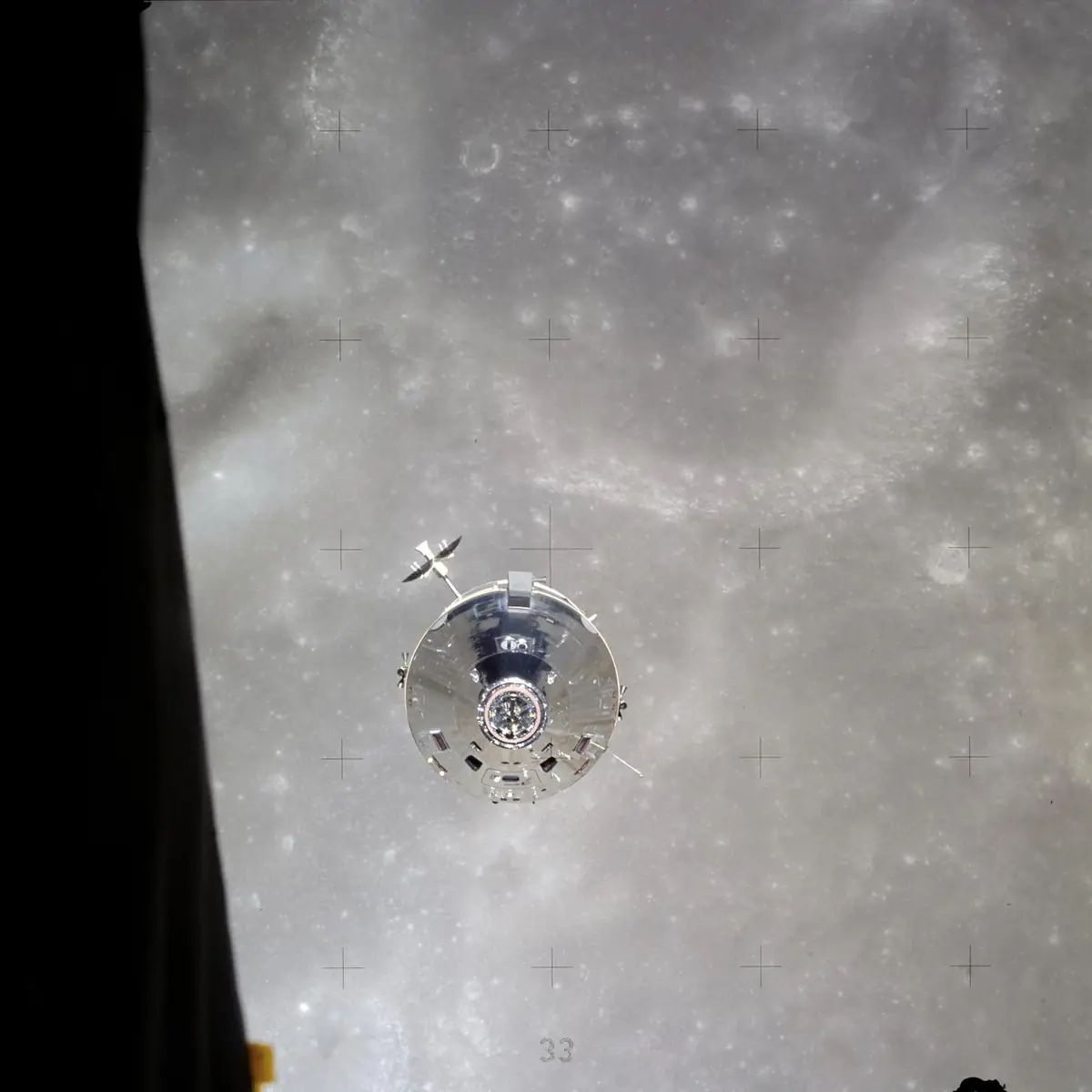
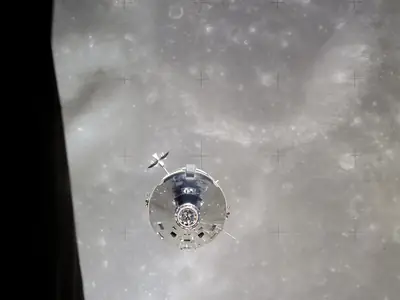 Casper approaches the ascent stage for docking.
-
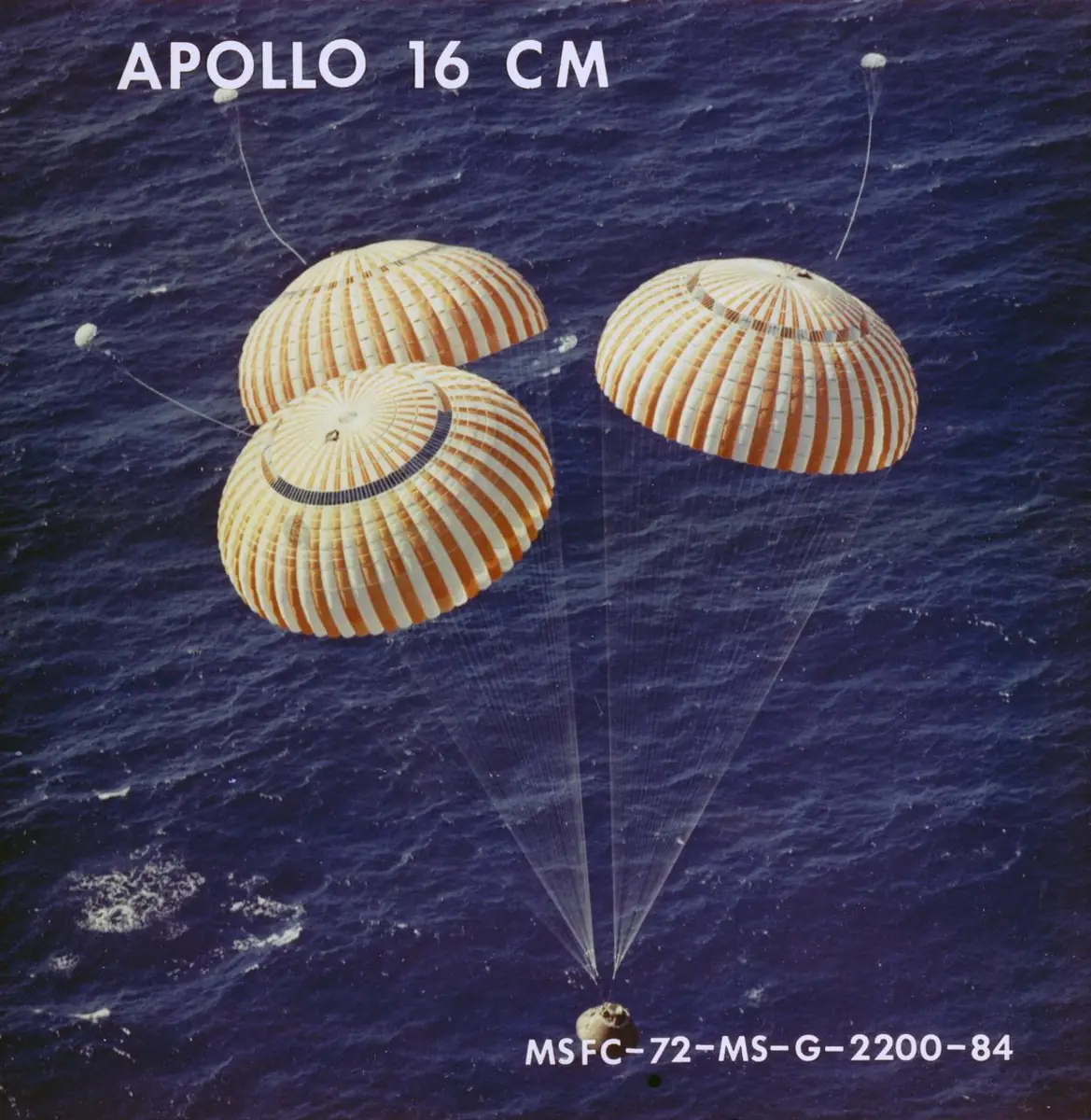
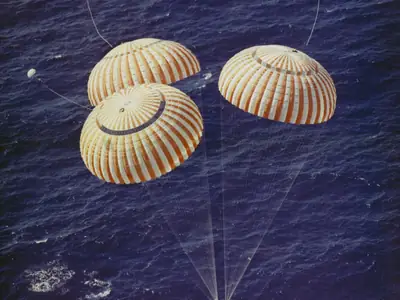 Casper descends to the central Pacific under three parachutes.
At a glance 13
-
Mission type
Type J-2: the second extended science mission and the only landing in the Moon's central highlands.
-
Dates
Launched 16 April 1972, landed 21 April (UTC; evening of 20 April in Houston), splashed down 27 April 1972.
-
Mission duration
265 h 51 min 5 s (11 days 1 h 51 min), cut one day short.
-
Call signs
Command module Casper (CM-113), after the friendly cartoon ghost, and lunar module Orion (LM-11).
-
Landing site
The smooth Cayley Plains among the hills of the Descartes Highlands, between North Ray and South Ray craters.
-
Coordinates
8.97301° S, 15.50019° E.
-
Time on the Moon
71 h 2 min 13 s.
-
Moonwalks
Three EVAs totalling 20 h 14 min 14 s.
-
Samples
95.71 kg (211.0 lb).
-
Rover
26.9 km16.7 miles driven in LRV-2.
-
Lunar orbits
64 orbits, 125 h 50 min in lunar orbit.
-
Designations
AS-511, Eastern Test Range #1601; CSM 1972-031A, subsatellite 1972-031D.
-
Distance flown
1,208,746 n mi (about 2.24 million km1.39 million miles).
Crew & team 12
-
John Young, commander
Capt., USN, born 24 September 1930 in San Francisco; 41 at launch. Georgia Tech aeronautical engineering (1952). His fourth spaceflight, after Gemini 3, Gemini 10 and Apollo 10, only the second person to fly four times.
-
Young later
Commanded STS-1, the first Space Shuttle flight, in 1981 and STS-9 in 1983. He died in January 2018.
-
Ken Mattingly, command module pilot
Lt. Cdr., USN, born 17 March 1936 in Chicago; 36 at launch. Auburn aeronautical engineering (1958), selected 1966. First flight.
-
Bumped from Apollo 13
Mattingly was pulled from Apollo 13 days before launch after exposure to German measles. He never caught them, and flew Apollo 16 instead.
-
Charlie Duke, lunar module pilot
Lt. Col., USAF, born 3 October 1935 in Charlotte, North Carolina; 36 at launch, the youngest person to walk on the Moon. Naval Academy 1957, M.S. MIT 1964.
-
The voice of Apollo 11
Duke had been the CAPCOM who talked Eagle down to Tranquility Base three years earlier.
-
Backup crew
Fred Haise, Stu Roosa and Edgar Mitchell.
-
Support crew
Don Peterson, Tony England, Hank Hartsfield and Philip Chapman.
-
Capsule communicators
Don Peterson, Gordon Fullerton, Jim Irwin, Fred Haise, Stu Roosa, Edgar Mitchell, Hank Hartsfield, Tony England (moonwalk CAPCOM) and Bob Overmyer.
-
Flight directors
Pete Frank and Phil Shaffer; Gene Kranz and Don Puddy; Gerry Griffin, Neil Hutchinson and Charles Lewis.
-
Weights
Launch-day weights 78.9 kg (Young), 61.5 kg (Mattingly) and 73.0 kg (Duke).
-
Where they are now
Young died in 2018 and Mattingly in 2023. Duke is one of four living moonwalkers.
Launch & Saturn V 9
-
Liftoff
17:54:00 GMT (12:54 p.m. EST) on 16 April 1972 from Pad 39A.
-
Weather
Fair and warm: 31.2 °C88.2 °F, 44% humidity, cumulus 20% at 910 m3,000 feet.
-
Heaviest Apollo
6,537,238 lb at ignition, the heaviest of all the Apollo Saturn Vs.
-
Most thrust
The S-IC produced 7.62 million lbf 35–38 s after liftoff, the highest measured of the series.
-
Ascent
Flight azimuth 72.034°; maximum dynamic pressure 726.81 lb/ft² at 86.0 s. Parking orbit 90.7 × 90.0 n mi (168 × 167 km104 × 104 miles) at 32.542°.
-
Translunar injection
A 341.92-s burn from 2:33:37.
-
S-IVB impact
Its telemetry failed before impact, so the time (75:08) and place were estimated from seismometer data.
-
Launch window
Planned for an 11.9° Sun angle at Descartes, open until 21:43 GMT.
-
Upper winds
Strongest winds on the way up: 50.7 knots (94 km/h58 mph) at 11.9 km38,880 feet.
Spacecraft 8
-
Command & service module
CSM-113, 66,949 lb at launch, with a SIM bay like Apollo 15's.
-
Orion
LM-11, 36,237 lb at launch.
-
Descent propellant
19,559 lb loaded, 18,327 lb burned; about 102 s of hover time left.
-
LRV-2
The second rover, identical in design to Apollo 15's.
-
Far ultraviolet camera
George Carruthers' gold-plated camera/spectrograph, the first telescope used on the Moon.
-
Flaking paint
After docking, particles streamed from the LM. TV showed shredded thermal paint on a panel; it posed no hazard.
-
Stuck antenna
Orion's steerable S-band antenna jammed, so early surface TV waited until the rover's antenna was set up.
-
Software
Colossus 3 (command module) and Luminary 1F (lunar module).
Flight & orbit 12
-
Docking
Separated at 3:04:59 and docked at 3:21:53, with 18 min of color TV.
-
False gimbal lock
At 38:18:56 Casper's computer flagged gimbal lock. It was a false signal, and new software was uplinked so the computer would ignore it.
-
Light flashes
The crew reported instant, white flashes with eyes closed, cosmic rays passing through their eyes.
-
Lunar orbit insertion
SIM door off at 69:59. A 374.90-s burn put them into a 170.3 × 58.1 n mi (315 × 108 km196 × 67 miles) orbit after a 71 h 55 min coast.
-
Landing on hold
After undocking at 96:13:31, Casper's main engine showed oscillations in a backup steering system. The craft flew in formation for 5 h 45 min while engineers decided it was safe.
-
Powered descent
Began nearly six hours late at 104:17:25 from 10.9 n mi (20 km13 miles) altitude and lasted 734 s.
-
Lunar liftoff
01:25:47 GMT on 24 April, televised from the rover; a 427.7-s burn into a 40.2 × 7.9 n mi (74 × 15 km46 × 9.1 miles) orbit.
-
Rendezvous
Docked at 177:41:18 after 81 h 27 min 47 s apart.
-
Tumbling ascent stage
After jettison, Orion's ascent stage lost attitude control and tumbled. It could not be crashed on purpose and stayed in orbit for about a year.
-
Short-lived subsatellite
The subsatellite went into a lower orbit than planned. Lumpy lunar gravity brought it down after 425 orbits, on 29 May 1972, on the far side.
-
Home a day early
Because of the engine scare, trans-Earth injection came 24 h early: a 162.29-s burn at 200:21:33 after 64 orbits.
-
Experiments en route
A 45-minute electrophoresis demonstration and ultraviolet photographs of Earth from 58,000 and 117,000 n mi (107,000 and 217,000 km67,000 and 135,000 miles).
Landing site 8
-
Touchdown
02:23:35 GMT on 21 April 1972 (9:23:35 p.m. EST on 20 April).
-
Accuracy
A few hundred metres north-west of the target (270 m886 feet in the mission report).
-
Margins
About 102 s of hover time left.
-
A higher Sun
The six-hour delay let the Sun climb to about 15° above the horizon at touchdown, instead of the planned 11.9°.
-
Level
Orion sat nearly level: 0° roll, 2.5° pitch up.
-
Why Descartes
The smooth Cayley Plains and the Descartes mountains were thought to be highland volcanic deposits, unlike anything sampled before.
-
Rough ground
The crew landed safely in rugged highland terrain without high-resolution pre-mission photos, and the rover handled slopes of up to 20°.
-
Landmarks
North Ray and South Ray craters, Stone Mountain and Smoky Mountain framed the site; Spook, Flag, Plum and Buster craters were nearby stops.
Moonwalks 12
-
EVA-1
7 h 11 min 2 s. ALSEP set up, then a drive west to Flag, Plum, Buster and Spook craters: 4.2 km2.6 miles, 29.9 kg.
-
A broken cable
Young's foot caught the heat flow experiment's cable and tore it from the central station, ending that experiment.
-
Jump salute
Young leapt off the ground in the one-sixth gravity, saluting the flag, while Duke photographed him.
-
Grand Prix
Young put the rover through sharp turns and stops on camera to test its handling.
-
EVA-2
7 h 23 min 9 s south to Stone Mountain and the Cinco craters, then Stubby and Wreck: 11.3 km7.0 miles, 29.0 kg.
-
EVA-3
5 h 40 min 3 s north to North Ray crater, about 1 km0.6 miles across, with House Rock and Shadow Rock: 11.4 km7.1 miles, 35.4 kg.
-
House Rock
The largest single rock seen on any of the three EVAs, sampled on North Ray's rim.
-
Shadow Rock
Young scooped soil from under an overhang where sunlight had probably never reached.
-
Family photo
Duke left a photograph of his family on the surface, signed on the back.
-
Totals
20 h 14 min 14 s outside, 26.9 km16.7 miles by rover, farthest point 4.6 km2.9 miles from Orion.
-
Broken antenna
Climbing in after EVA-2, Young snapped part of his backpack antenna, cutting its signal by 15–18 dB. For EVA-3 he used Duke's oxygen purge system, which carried an antenna.
-
Early start, fewer stops
EVA-3 began 30 minutes early but four stations were dropped to fit the shortened timeline.
Surface science 9
-
ALSEP
Passive seismometer, lunar surface magnetometer, heat flow experiment and active seismic experiment.
-
Mortar fire
After the crew left, three of the four seismic grenades were launched by command, the farthest about 900 m3,000 feet.
-
Thumper
Nineteen thumper charges were fired along the geophone line during the EVAs.
-
Strongest field
The portable magnetometer measured 313 nT near North Ray, the strongest field measured on another planetary body at the time.
-
Telescope on the Moon
The far-UV camera took the first images of Earth's hydrogen geocorona from outside it and revealed two auroral belts.
-
Cosmic ray detector
Plates on the LM recorded cosmic-ray and solar particle tracks.
-
Solar wind sail
Exposed for 45 h 5 min, the longest of Apollo.
-
Lesson learned
Losing the heat flow experiment taught designers to build gear that survives crew in stiff suits who can't see their feet.
-
Magnetometer network
The surface magnetometer completed a three-station network with Apollo 12 and 15 to measure how the whole Moon responds to solar and terrestrial magnetic fields.
Rocks & discoveries 9
-
What came home
95.71 kg from the highlands.
-
Breccias, not lava
Young and Duke found “breccias, breccias, and more breccias”. The plains were impact debris, not volcanic rock, which reshaped models of the highlands.
-
Big Muley
Sample 61016, 11.7 kg, collected near Plum crater: the largest rock returned by Apollo, named for field geology leader Bill Muehlberger.
-
Anorthosite
Pieces of pale, plagioclase-rich anorthosite, part of the Moon's early crust, came home from the highlands.
-
Young craters
Exposure ages put North Ray crater at about 50 million years old and South Ray at about 2 million.
-
Shadowed soil
Soil from beneath Shadow Rock was taken to compare with sunlit soil.
-
Sample numbers
Apollo 16 samples are numbered 6xxxx; the second digit marks the station, so 61016 is from Station 1.
-
Crushed feldspar
Rock 67015 is typical of the site: a white breccia of crushed, feldspar-rich debris.
-
Cores
Double core tubes were driven at the ALSEP site to sample layered soil.
Alone in orbit 6
-
Mattingly solo
Ken Mattingly flew Casper alone for most of 81 h 27 min, running the SIM bay.
-
Mapping
Panoramic, mapping and laser altimeter data plus gamma-ray, X-ray and alpha-particle surveys repeated and extended Apollo 15's coverage.
-
Deep-space EVA
On the way home Mattingly spent 1 h 23 min 42 s outside retrieving film and exposing a microbial experiment for ten minutes.
-
Guyot crater
On the far side the crew described Guyot crater as brim-full of material that seemed to have overflowed.
-
Later career
Mattingly commanded Shuttle missions STS-4 and STS-51-C.
-
Boom jettisoned
The SIM bay mass spectrometer boom stalled while retracting and was jettisoned at 195:23.
Return & recovery 8
-
Entry
Peak load 7.19 g, the highest of the lunar returns.
-
Splashdown
19:45:05 GMT on 27 April 1972 at 0.70° S, 156.22° W in the central Pacific, about 3 n mi (5.6 km3.5 miles) from target and 2.7 n mi (5.0 km3.1 miles) from USS Ticonderoga (CVS-14).
-
On TV
The descent under parachutes was televised and the crew was aboard ship in 37 minutes.
-
Upside down
Casper floated apex-down and was righted in 4.5 min.
-
Detanking blast
On 7 May a cart used to drain the CM's leftover propellant exploded; 46 people were checked in hospital and Casper was undamaged.
-
Recovery force
4 ships and 17 aircraft.
-
Where Casper is
Displayed at the U.S. Space & Rocket Center in Huntsville, Alabama.
-
Flying home
The crew left Ticonderoga for Hawaii on 29 April and reached Houston on 30 April 1972.
Moments & legacy 5
-
The patch
An eagle on a red, white and blue shield over the grey lunar surface, with a gold NASA vector and 16 stars.
-
Potassium
To avoid Apollo 15's heart rhythm problems, the crew drank potassium-fortified juice. Young's candid complaints about it went out on an open mic.
-
Highlands rethink
The surprise at Descartes showed that the highlands were shaped by impacts rather than volcanoes.
-
From orbit today
LRO images show Orion's descent stage, the rover, the ALSEP and even the portable magnetometer.
-
Duke's photo
The family photograph is still on the Moon, near Orion's descent stage.
Seven missions side by side
Figures from NASA's Apollo by the Numbers. Select a mission to open its dossier.
| Measure | Apollo 11 | Apollo 12 | Apollo 13 | Apollo 14 | Apollo 15 | Apollo 16 | Apollo 17 |
|---|---|---|---|---|---|---|---|
| Landing (UTC) | 20 July 1969 | 19 November 1969 | did not land | 5 February 1971 | 30 July 1971 | 21 April 1972 | 11 December 1972 |
| Landing site | Mare Tranquillitatis | Oceanus Procellarum | Fra Mauro highlands (planned) | Fra Mauro highlands | Hadley–Apennine | Descartes Highlands | Taurus–Littrow valley |
| Lunar module | Eagle (LM-5) | Intrepid (LM-6) | Aquarius (LM-7) | Antares (LM-8) | Falcon (LM-10) | Orion (LM-11) | Challenger (LM-12) |
| Command module | Columbia (CM-107) | Yankee Clipper (CM-108) | Odyssey (CM-109) | Kitty Hawk (CM-110) | Endeavour (CM-112) | Casper (CM-113) | America (CM-114) |
| Commander | Neil Armstrong | Pete Conrad | Jim Lovell | Alan Shepard | David Scott | John Young | Gene Cernan |
| Lunar module pilot | Buzz Aldrin | Alan Bean | Fred Haise | Edgar Mitchell | Jim Irwin | Charlie Duke | Harrison Schmitt |
| Command module pilot | Michael Collins | Dick Gordon | Jack Swigert | Stuart Roosa | Al Worden | Ken Mattingly | Ron Evans |
| Mission type | G | H-1 | H-2 | H-3 | J-1 | J-2 | J-3 |
| Time on the Moon | 21 h 36 min | 31 h 31 min | none | 33 h 30 min | 66 h 54 min | 71 h 2 min | 74 h 59 min |
| Moonwalks | 1 · 2 h 31 min | 2 · 7 h 45 min | none | 2 · 9 h 22 min | 3 · 18 h 34 min | 3 · 20 h 14 min | 3 · 22 h 3 min |
| Samples | 21.55 kg | 34.35 kg | none | 42.28 kg | 77.31 kg | 95.71 kg | 110.52 kg |
| Farthest from the lunar module | 60 m200 feet | ≈ 410 m1,350 feet | none | ≈ 1.45 km0.9 miles | ≈ 5.0 km3.1 miles | ≈ 4.6 km2.9 miles | ≈ 7.6 km4.7 miles |
| Rover distance | none | none | none | none | 27.9 km17.3 miles | 26.9 km16.7 miles | 35.7 km22.2 miles |
| Sun at landing | 10.8° | 5.1° | none | 10.3° | 12.2° | 14.8° | 13.0° |
| Lunar orbits | 30 | 45 | none (flyby) | 34 | 74 | 64 | 75 |
| Mission length | 8 d 3 h 18 min | 10 d 4 h 36 min | 5 d 22 h 54 min | 9 d 0 h 1 min | 12 d 7 h 11 min | 11 d 1 h 51 min | 12 d 13 h 51 min |
| Recovery ship | USS Hornet | USS Hornet | USS Iwo Jima | USS New Orleans | USS Okinawa | USS Ticonderoga | USS Ticonderoga |
| Sourced facts | 130 | 113 | 134 | 112 | 110 | 111 | 112 |
Sources and method
27 sources, how the Moon is drawn, and photo credits
Source
Apollo Preliminary Science Reports, NASA SP-214, SP-235, SP-272, SP-289, SP-315, SP-330
All sourcesSource
A. Saunders, The Mystery Behind Alan Shepard's 'Moon Shot' Revealed, USGA, Feb 2021
All sourcesSource
All sourcesSource
NASA/JPL, First Confirmed Capture into Earth Orbit Is Likely Apollo Rocket (2002)
All sourcesSource
NASA History, 50 Years Ago: Apollo 13 Review Board Report (on the Cortright report, June 1970)
All sourcesSource
NASA, Acting NASA Administrator Reflects on Legacy of Astronaut Jim Lovell, Aug 2025
All sourcesSource
All sources