
The true story of Apollo
Footprints on the Moon
How people built a giant rocket, flew to another world and walked on it. Here are the first steps, a car driven on the Moon, a rescue in deep space and the footprints that are still up there today.
-
A giant challenge
In 1961, nobody had ever been to the Moon. That April, Yuri Gagarin of the Soviet Union became the first person in space, circling Earth once. A few weeks later, US President John F. Kennedy announced a huge goal: land astronauts on the Moon and bring them home safely before 1970. The Moon is about 384,400 km238,855 miles away, and nobody yet knew exactly how to get there.
8 years from the goal to the first landing
1 of 15Where these facts come from
- Apollo 11: the mission (Gagarin's flight, Kennedy's challenge)Smithsonian National Air and Space Museum
- Apollo 11 mission overview (Kennedy's goal, the landing, the first step)NASA
- Earth's Moon: facts (distance, gravity about one sixth of Earth's)NASA Science
-
A team of 400,000
Getting there took about 400,000 people. Engineers designed the rockets and spacecraft. Mathematicians such as Katherine Johnson calculated the paths through space. Margaret Hamilton led the team that wrote the software for the spacecraft's computers; printed out, the code made a tall stack of paper. Expert sewers stitched each spacesuit by hand, layer by layer.
400,000 people worked on Apollo
2 of 15Where these facts come from
- Apollo 50th: We Hack the Moon (about 400,000 people worked on Apollo)NASA
- The women of Apollo: Katherine Johnson and Margaret HamiltonSmithsonian Magazine
- Neil Armstrong's Apollo 11 spacesuit (as many as 21 layers, sewn by hand)Smithsonian National Air and Space Museum
-
The Saturn V
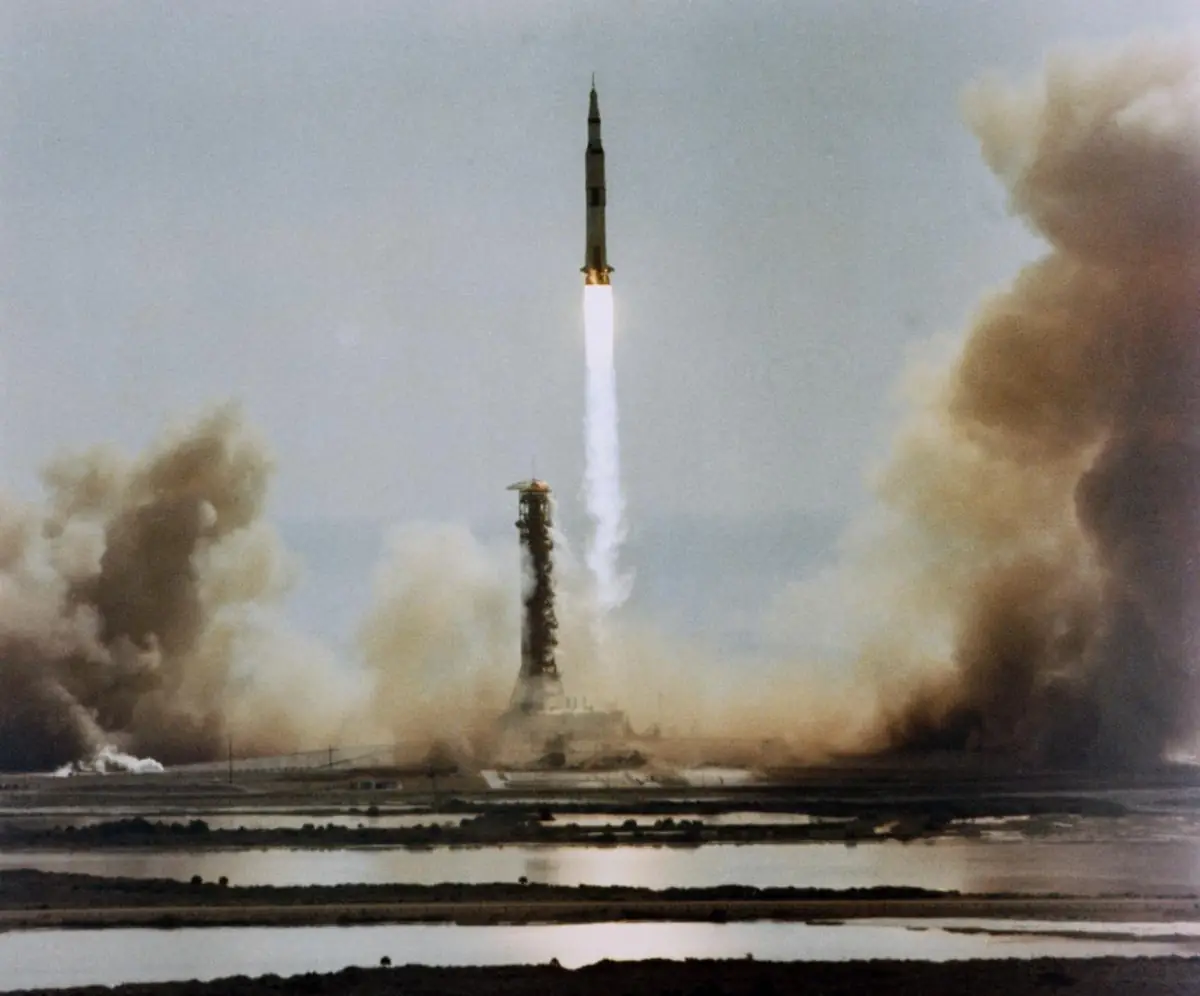
The rocket that carried astronauts to the Moon was the Saturn V (you say "Saturn five"). Standing up, it was as tall as a 36-story building. It had three stages stacked on top of each other: when one ran out of fuel, it dropped away and the next one fired. The three astronauts rode in a small capsule at the very top, under an escape rocket that could pull them clear if something went wrong.
111 m363 ft tall, on the launch pad
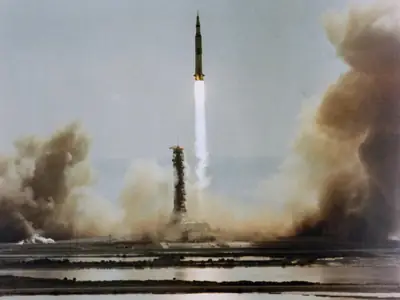
NASA photo: Apollo 11 lifts off, July 16, 1969. 3 of 15Where these facts come from
- What was the Saturn V? (for students, grades 5 to 8)NASA
- 10 Things: Rockets We Love, the Saturn V (363 feet, a 36-story building)NASA
- The real photos on this page (NASA did not endorse this page)NASA Image and Video Library
-
Three days in space
After one and a half trips around Earth, the rocket's third stage fired again and sent the spacecraft toward the Moon at about 39,000 km/h24,000 mph, fast enough to circle the whole Earth in about an hour. The trip took about three days. Inside, there was no up or down: the astronauts floated, slept in sleeping bags and ate from food pouches.
~3 days from Earth to the Moon
4 of 15Where these facts come from
- Apollo 11 mission overview (Kennedy's goal, the landing, the first step)NASA
- Apollo 11 translunar phase: 35,546 feet per second at translunar injectionR. W. Orloff, Apollo by the Numbers (NASA SP-4029)
-
Earth from far away
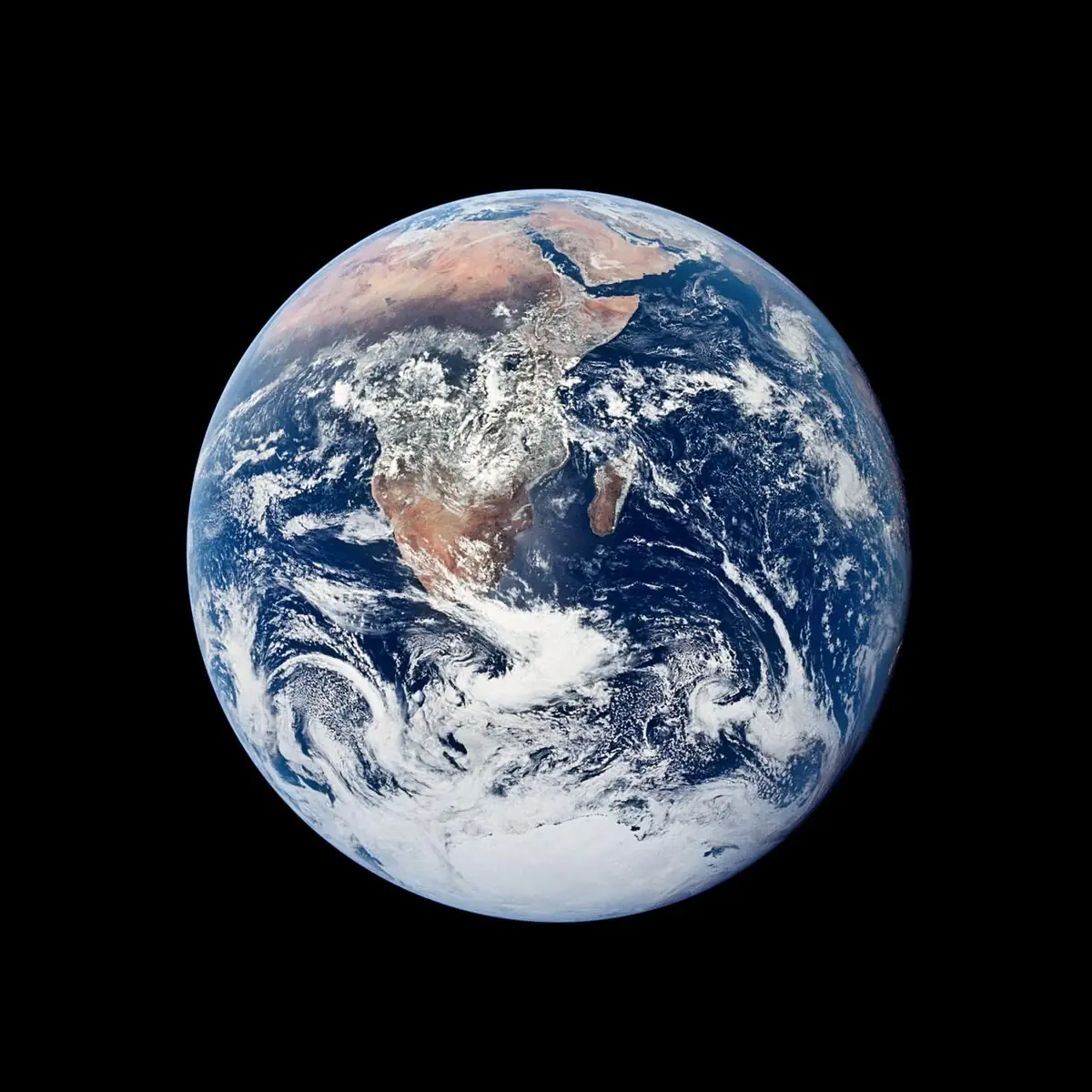
Seen from near the Moon, Earth looks small: a blue-and-white ball hanging in the black sky. Jim Lovell flew on Apollo 8, the first mission to carry people around the Moon. He found he could hide the whole planet behind his thumb. "Everything I ever knew was behind my thumb," he said years later.
1968 first people to orbit the Moon
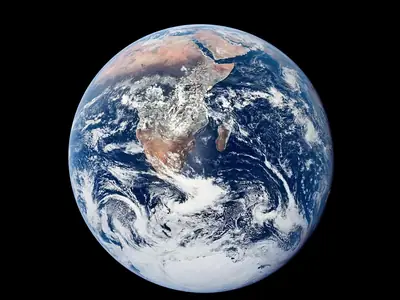
NASA photo: the whole Earth, taken by the Apollo 17 crew. 5 of 15Where these facts come from
- Jim Lovell: an Apollo 8 astronaut remembers looking down at EarthSmithsonian National Air and Space Museum
- The real photos on this page (NASA did not endorse this page)NASA Image and Video Library
-
The Eagle has landed
On July 20, 1969, Neil Armstrong and Buzz Aldrin flew the lunar module, named Eagle, down to the surface. Their crewmate Michael Collins stayed in orbit in the command module Columbia. Near the end, Armstrong steered by hand and flew past a crater to find a safe place to land. Then they radioed Earth: "The Eagle has landed."
650 million people watched on TV
6 of 15Where these facts come from
All sources -
One small step
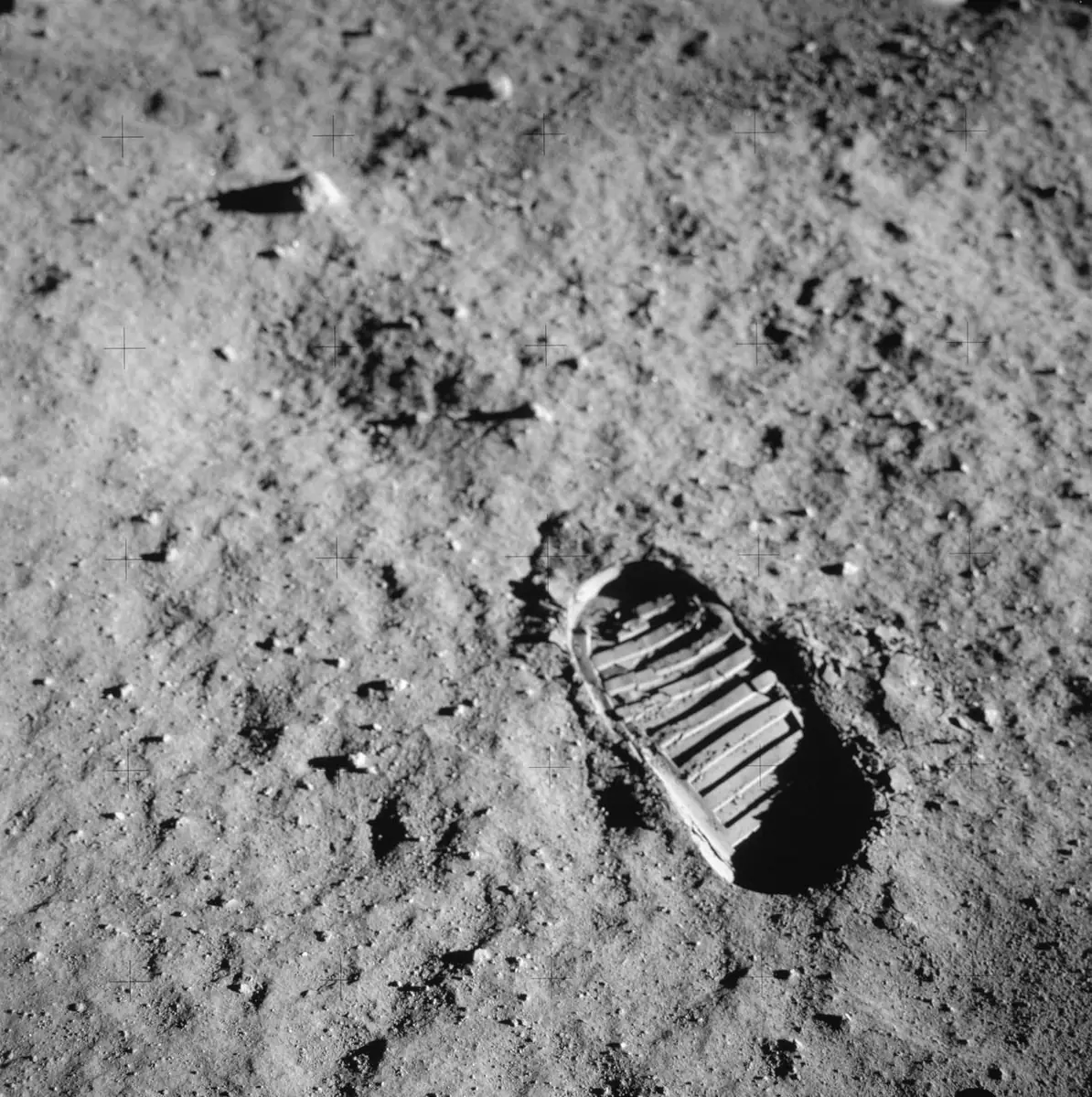
Almost seven hours later, Armstrong climbed down the ladder and put his boot on the Moon: "That's one small step for a man, one giant leap for mankind." His spacesuit worked like a personal spaceship, with up to 21 layers against heat, cold and tiny flying grains of space dust. The Moon has no wind or rain, so the astronauts' trails are still there; a spacecraft orbiting the Moon has photographed them.
21 layers in a moonwalker's spacesuit
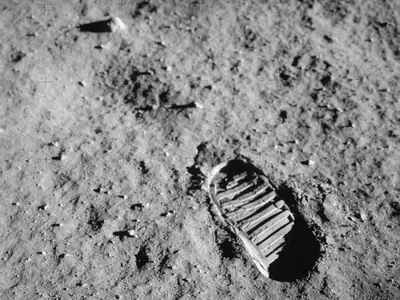
NASA photo: Buzz Aldrin's bootprint in the Moon's dust. 7 of 15Where these facts come from
- Apollo 11 mission overview (Kennedy's goal, the landing, the first step)NASA
- Neil Armstrong's Apollo 11 spacesuit (as many as 21 layers, sewn by hand)Smithsonian National Air and Space Museum
- New LRO images offer sharper views of Apollo 12, 14 and 17 sites (astronauts' paths still visible)NASA Scientific Visualization Studio
- The real photos on this page (NASA did not endorse this page)NASA Image and Video Library
-
Bouncing in low gravity
The Moon's gravity is only about one sixth as strong as Earth's, so everything weighs a sixth as much. Astronauts found that hopping was often easier than walking, and when they fell over, they went down in slow motion. If you jumped on the Moon, you could go about six times as high. On Apollo 14, Alan Shepard even hit two golf balls.
1/6 of Earth's gravity
8 of 15Where these facts come from
- Earth's Moon: facts (distance, gravity about one sixth of Earth's)NASA Science
- The mystery behind Alan Shepard's Moon shot revealed (2021)A. Saunders, USGA
-
The hammer and the feather
Almost 400 years ago, the scientist Galileo worked out that without air, a heavy object and a light one fall at the same speed. On Earth, air slows a feather down, so it's hard to test. The Moon has no air. On Apollo 15, Dave Scott dropped a geology hammer and a falcon feather at the same moment, live on TV. They hit the ground together. Galileo was right.
No air so nothing slows the feather
9 of 15 -
A car on the Moon
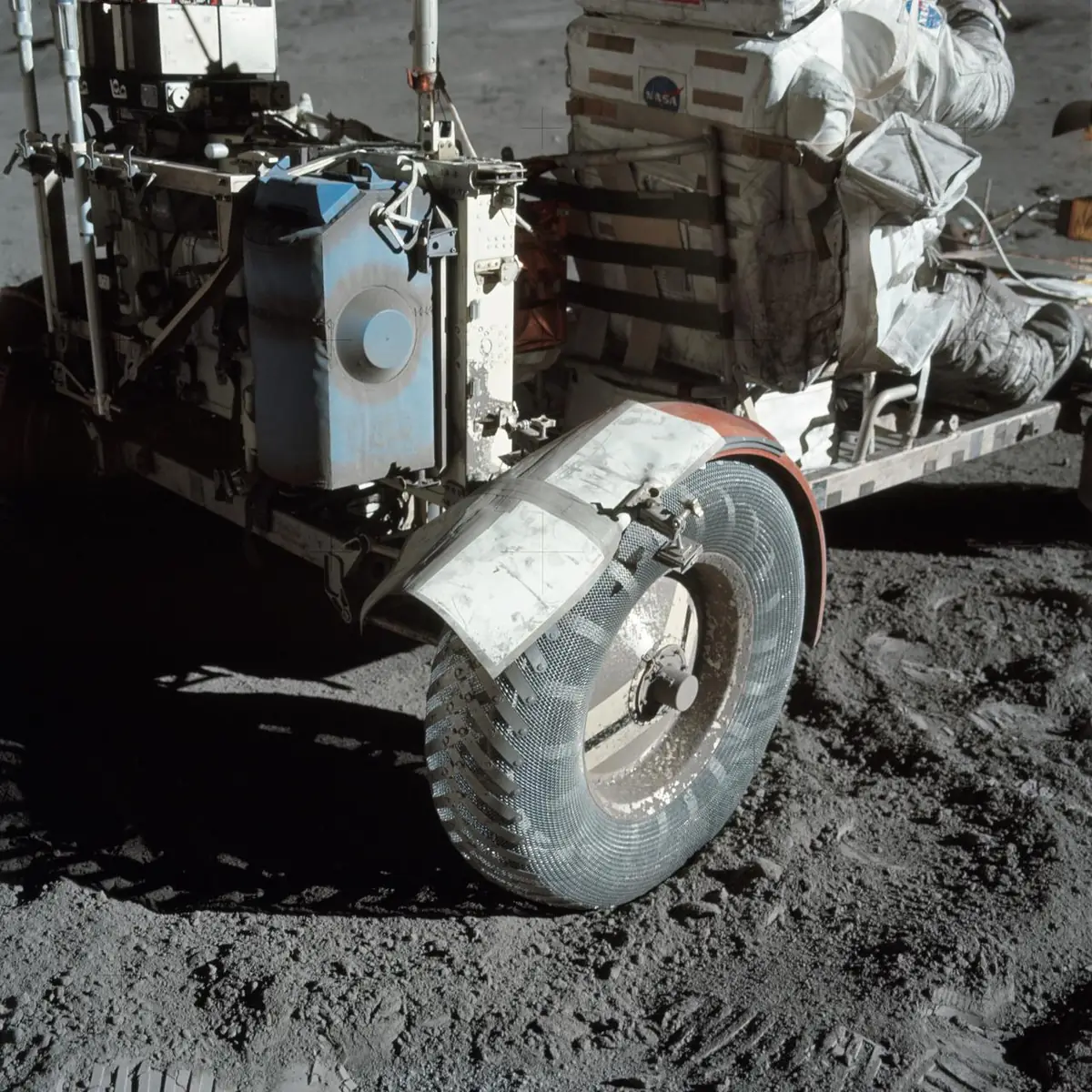
The last three missions brought a battery-powered car, the Lunar Roving Vehicle. It traveled folded up in a bay on the side of the lunar module and opened out on the surface. Its tires were woven from springy steel wire instead of rubber. On Apollo 17, a fender broke off, and the wheels sprayed dust everywhere, so the crew built a new fender out of four maps, tape and clamps.
18 km/h11 mph fastest speed driven on the Moon
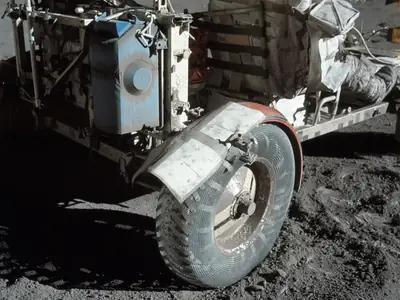
NASA photo: the Apollo 17 rover's map-and-tape fender. 10 of 15Where these facts come from
- Where No Man Has Gone Before: the lunar roving vehicle (folded, wire-mesh tires)NASA History, SP-4214
- The Moon buggy: Cernan's 18 km/h record (Guinness World Records)The Register
- Apollo 17 replacement fender: tape, maps and clampsNASA, Apollo Lunar Surface Journal
- The real photos on this page (NASA did not endorse this page)NASA Image and Video Library
-
Rocks from another world
The astronauts brought home 2,196 samples of rock and soil, all together nearly as heavy as a horse. On Apollo 17, geologist Harrison "Jack" Schmitt spotted orange soil. Under a microscope it turned out to be tiny beads of glass, sprayed out by volcanic fire fountains billions of years ago. Moon rocks also helped scientists work out how the Moon formed: most likely in a giant crash between the young Earth and another world.
2,196 rock and soil samples
11 of 15Where these facts come from
- We did this before: the Lunar Receiving Laboratory (2,196 samples)NASA Technical Reports Server
- Where are NASA's Apollo Moon rocks now? (nearly as heavy as a horse)Space.com
- Apollo Expeditions to the Moon: beads of orange glassNASA History, SP-350
- Moon formation: how did the Moon form?NASA Science
-
"Houston, we've had a problem"
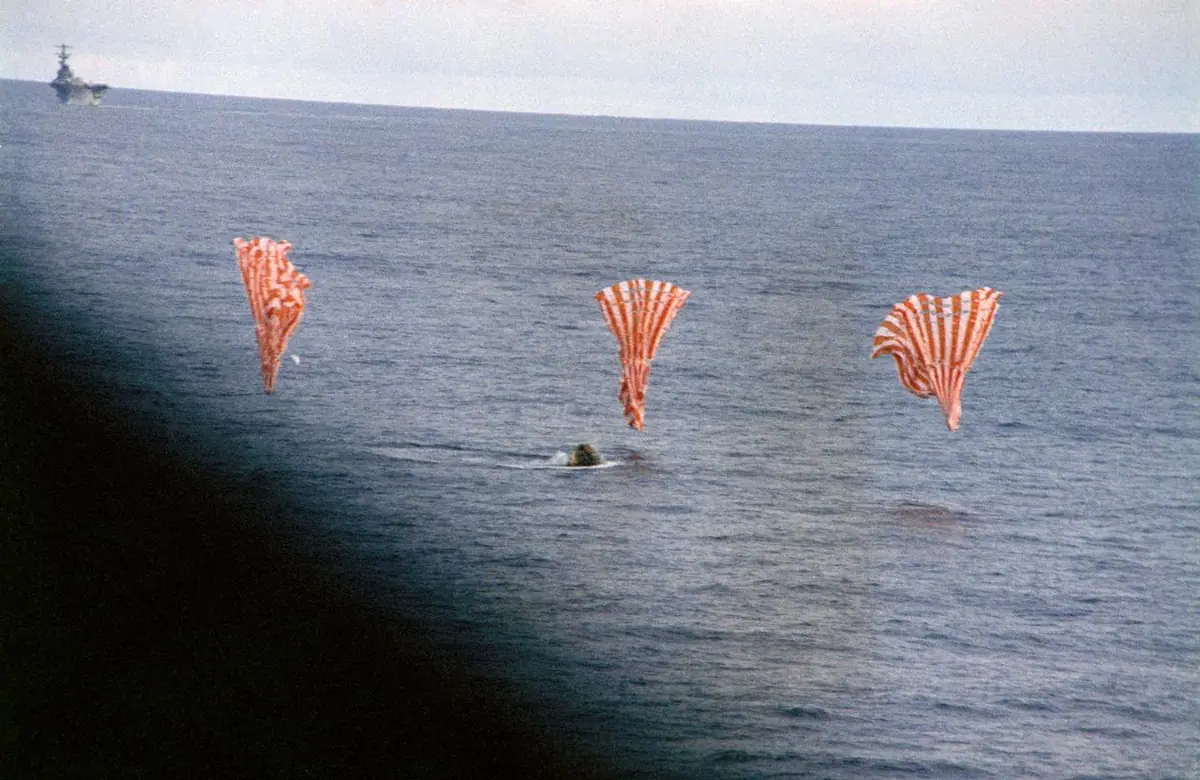
In April 1970, Apollo 13 was on its way to the Moon when an oxygen tank burst and damaged the spacecraft. Landing was now impossible. The three astronauts used the lunar module as a lifeboat and swung around the Moon to head home. When carbon dioxide began building up in the air, engineers on Earth invented a fix from plastic bags, cardboard and tape, and talked the crew through building it. All three got home safely.
3 of 3 crew home safe
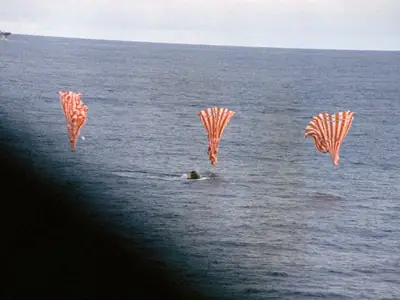
NASA photo: Apollo 13 splashes down safely, April 17, 1970. 12 of 15Where these facts come from
- Apollo 13: the successful failureNASA
- Apollo Expeditions to the Moon: "Houston, we've had a problem" (plastic bags, cardboard and tape)NASA History, SP-350
- The real photos on this page (NASA did not endorse this page)NASA Image and Video Library
-
What they left behind
Three Apollo crews set up panels of mirrors on the Moon. Scientists on Earth still fire lasers at them and time how long the light takes to bounce back. That's how we know the Moon is drifting away by about 3.8 cm1.5 inches a year, roughly as fast as your fingernails grow. Some things were personal: Charlie Duke left a photo of his family, and Gene Cernan, the last person to walk on the Moon, traced his daughter's initials in the dust.
3.8 cm1.5 in farther away each year
13 of 15Where these facts come from
- Apollo 11's last working experiment on the Moon (still in use; 38 mm a year)JILA, University of Colorado
- Seeing the light: the Apollo 11, 14 and 15 reflectors still in useEos
- Will Earth ever lose its Moon? (about the rate fingernails grow)Live Science
- Airman on the Moon: Charlie Duke's family photo on the lunar surfaceAir & Space Forces Magazine
- Gene Cernan, last astronaut on the Moon, dies at 82 (his daughter's initials in the dust)Associated Press
-
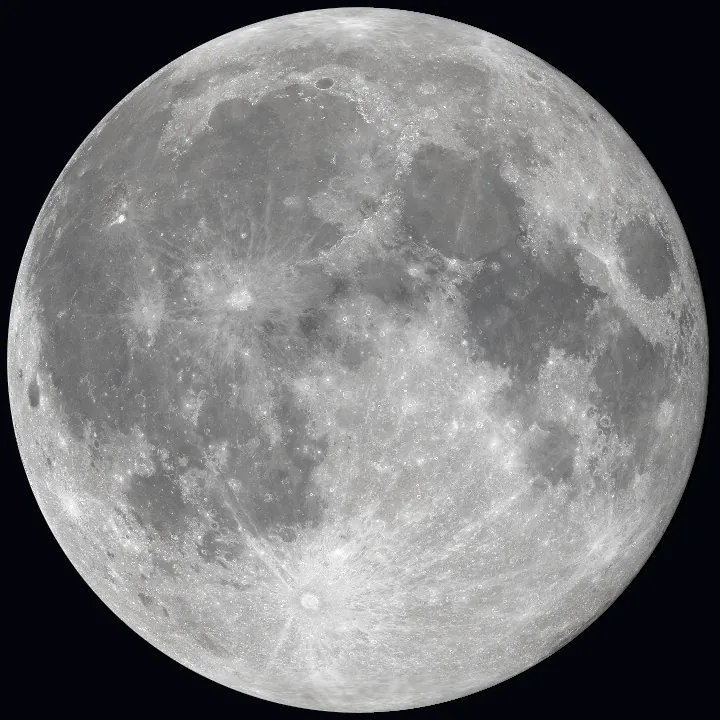
Twelve moonwalkers
Between July 1969 and December 1972, six Apollo missions landed and twelve astronauts walked on the Moon. The flags on this picture of the real Moon mark their landing sites. All six are on the near side, the side that always faces Earth. So the next time the Moon is up, you are looking at the places where people once walked.
12 people have walked on the Moon
- 11 Sea of Tranquility, 1969
- 12 Ocean of Storms, 1969
- 14 Fra Mauro hills, 1971
- 15 Hadley Rille, 1971
- 16 Descartes Highlands, 1972
- 17 Taurus-Littrow valley, 1972
14 of 15Where these facts come from
- Moonwalkers: the twelve people who walked on the MoonNASA Science
- Landing sites and dates of the six landingsR. W. Orloff, Apollo by the Numbers (NASA SP-4029)
-
Who's next?
In April 2026, the four astronauts of Artemis II flew around the Moon and back, farther from Earth than any people before them. Christina Koch became the first woman to travel to the Moon. NASA plans to land astronauts near the Moon's south pole as soon as 2028. Maybe one day, someone reading this will go too.
2028 next landing planned
15 of 15Where these facts come from
- NASA welcomes record-setting Artemis II moonfarers back to Earth (April 2026)NASA
- Artemis II's record-breaking journey around the Moon ends with dramatic splashdownAssociated Press
- NASA's Artemis III mission to test future Moon lander operations (landings near the south pole in 2028)NASA
Mission complete
Next time the Moon is up, look at its dark patches. That's where people walked.